
5G edge computing combines ultra-fast 5G wireless networks with localized data processing infrastructure positioned close to where energy is generated, consumed, and managed. Instead of sending sensor data to distant cloud servers for analysis, edge computing processes information on-site within milliseconds, while 5G provides the high-speed, low-latency wireless connectivity needed to coordinate thousands of devices simultaneously. For the power grid, this pairing enables real-time control of distributed energy resources, instant response to grid fluctuations, and the coordination of renewable assets at a scale previously impossible.
This technology convergence arrives at a critical moment in the energy transition. As utilities integrate more solar panels, wind turbines, battery storage systems, and electric vehicle charging stations, the grid becomes exponentially more complex. A single substation might now manage hundreds of rooftop solar installations, commercial batteries, and bidirectional EV chargers, each requiring split-second coordination. Traditional grid infrastructure, designed for one-way power flow from large central plants, struggles with this distributed model. The computational demands exceed what centralized systems can handle, and the wireless connectivity requirements overwhelm older cellular networks.
5G edge computing addresses both bottlenecks simultaneously. The edge layer handles intensive computing tasks locally, analyzing power flows, predicting demand spikes, and balancing supply without waiting for instructions from headquarters. The 5G layer provides the wireless backbone to connect every device reliably, supporting up to one million connections per square kilometer with latency under 10 milliseconds. Together, they create what grid operators call “intelligent automation at the edge,” where microgrids can self-optimize, substations can autonomously prevent outages, and renewable energy can be harvested with precision once reserved for conventional power plants.
This article explains how 5G edge computing actually functions in grid environments, identifies the core components utilities are deploying in 2026, and examines real-world implementations already delivering measurable results in reliability and clean energy integration.
What 5G Edge Computing Means for Energy Systems
5G edge computing brings together two powerful technologies, fifth-generation wireless networks and edge computing, to process data closer to where it’s generated rather than sending it to distant data centres. For energy systems, this means grid equipment, sensors, and distributed energy resources can communicate and make decisions in near real-time, fundamentally changing how the grid edge operates.
To understand what this means in practice, it helps to break down the core concepts:
- 5G Networks
- Fifth-generation cellular networks that deliver wireless connectivity with speeds up to 100 times faster than 4G, supporting millions of connected devices per square kilometre. These networks reduce communication delays to as low as one millisecond, enabling time-sensitive grid operations.
- Edge Computing
- A distributed computing approach that processes and analyses data at or near its source rather than sending it to centralised cloud servers. This architecture eliminates the round-trip journey to distant data centres, enabling instant decision-making for grid equipment.
- Latency
- The time delay between sending a command and receiving a response, measured in milliseconds. Ultra-low latency is critical for grid operations like fault detection and automated switching that require split-second responses.
- Network Slicing
- A 5G capability that creates multiple virtual networks on shared physical infrastructure, each optimised for specific applications. Energy utilities can deploy dedicated network slices for critical grid operations, guaranteeing performance and security.
- Distributed Computing Architecture
- A system design that spreads computational resources across multiple locations rather than concentrating them in central facilities. This approach matches the physical reality of modern grids, where generation, storage, and control points are scattered across vast service territories.
When these technologies converge, they create infrastructure fundamentally different from what came before. Traditional grid systems rely on cloud computing, where data from a solar array or battery storage unit travels hundreds of miles to a central server for processing, then returns with instructions. Even with 4G networks, this round trip introduces delays of 50 milliseconds or more, which sounds quick but falls short for managing rapid grid fluctuations or coordinating thousands of distributed energy resources responding to the same price signal.
5G edge computing flips this model. A micro data centre located at a distribution substation can process data from nearby solar panels, EVs charging, and home batteries within a few milliseconds, then execute control decisions without waiting for approval from distant servers. The 5G network provides the high-capacity wireless backbone connecting everything, while edge computing delivers the local intelligence to act instantly on that information. For energy systems dealing with intermittent renewables and bidirectional power flows, this speed and responsiveness isn’t just convenient, it’s essential.
How 5G Edge Computing Works at the Grid Edge
The Network Layer: 5G Connectivity
At the foundation of 5G edge computing sits a wireless infrastructure fundamentally different from its predecessors. Where 4G delivered adequate connectivity for smartphones and consumer devices, 5G was designed with industrial applications in mind, and energy infrastructure demands extreme reliability.
The performance metrics tell the story: 5G achieves latency below 10 milliseconds, sometimes as low as 1ms in optimal conditions, compared to 4G’s 50-100ms lag. For a solar inverter responding to grid frequency fluctuations or a battery storage system balancing load in real time, those milliseconds determine whether the system can react before instability cascades. Bandwidth jumps from 4G’s peak of 100 Mbps to 5G’s theoretical 20 Gbps, enabling thousands of sensors across a distributed energy installation to transmit data simultaneously without congestion.
Network slicing represents 5G’s most transformative feature for grid operators. This technology partitions a single physical 5G network into multiple virtual networks, each customized for specific performance requirements. A utility can dedicate one slice to critical grid control systems requiring guaranteed low latency and ultra-high reliability (99.999% uptime), while routing routine meter readings and less time-sensitive monitoring data through a separate slice optimized for efficiency over speed. This segregation also enhances security, compromising one network slice doesn’t provide access to others.
Spectrum deployment varies by region and operator, typically using a mix of low-band frequencies (sub-1 GHz) for wide area coverage, mid-band (1-6 GHz) balancing range and capacity, and millimeter wave bands (24-47 GHz) delivering the highest speeds over shorter distances, ideal for dense equipment clusters at substations or solar farms.
The Computing Layer: Edge Data Processing
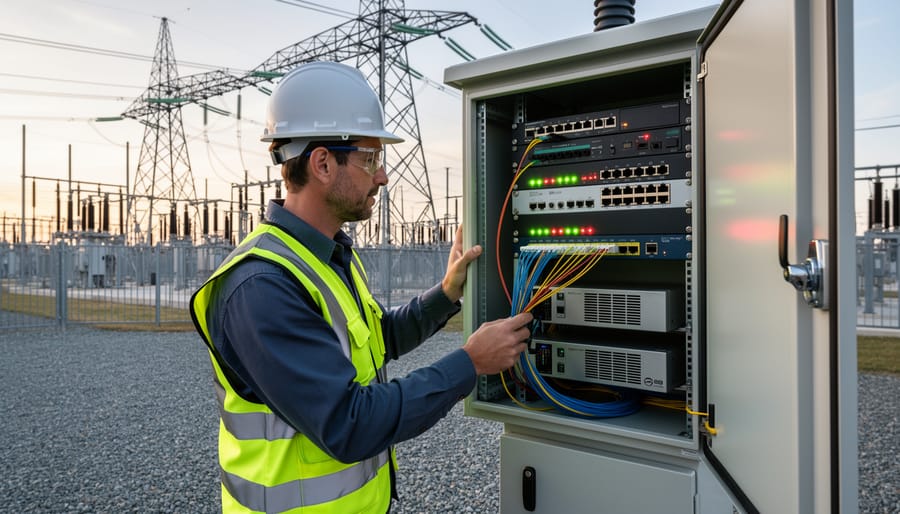
Edge computing fundamentally repositions where data processing happens in the energy infrastructure. Instead of shuttling information from a solar inverter or battery system hundreds of miles to a distant data center, computational resources sit right at the grid edge, often within substations, microgrids, or even inside the equipment itself.
This distributed architecture places compact servers, specialized processors, and analytics software physically close to where energy data originates. A battery storage facility, for instance, might have edge computing hardware on-site that analyzes charge states, grid conditions, and pricing signals in milliseconds, making autonomous decisions about when to discharge power without waiting for instructions from a central control room.
The processing power varies based on need. Some edge devices run lightweight algorithms for immediate tasks like voltage regulation or fault detection. Others deploy sophisticated machine learning models that predict solar generation patterns or optimize microgrid operations. What matters is proximity: keeping the compute-intensive work local dramatically reduces the time between data collection and action.
This local intelligence creates a tiered computing model. Time-critical operations, like preventing equipment damage during a voltage spike, happen instantly at the edge. Less urgent analytics, such as weekly efficiency reports or long-term forecasting, can still route to centralized cloud systems when bandwidth allows.
The hardware itself often includes rugged industrial servers designed for harsh electrical environments, equipped with GPUs or specialized AI chips for complex calculations. These edge nodes form a distributed network of decision-makers, each handling its local domain while coordinating with neighbors and, when necessary, with central operations. This creates resilient, responsive grid infrastructure that keeps functioning even if connectivity to headquarters drops.
Core Components of 5G Edge Computing Infrastructure
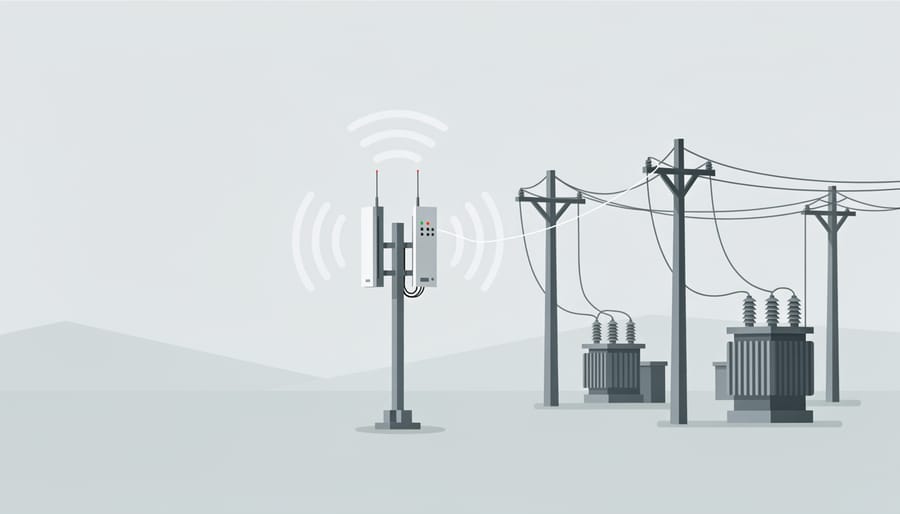
A complete 5G edge computing system for grid applications consists of several interconnected technology layers that work together to enable real-time data processing and control at the distribution edge. Understanding these components helps clarify how utilities can architect solutions that meet specific operational requirements while maintaining the flexibility to scale as needs evolve.
The physical infrastructure forms the foundation of any deployment. At the network level, 5G small cells and base stations provide the wireless connectivity blanket across service territories, often mounted on existing utility poles or substations to minimize deployment costs. These cells create the high-bandwidth, low-latency pathways that distinguish 5G from previous wireless generations. Edge servers and micro data centers represent the distributed computing nodes placed strategically throughout the grid, often housed in hardened enclosures at substations or other utility facilities where they can process data from nearby assets without sending it to distant cloud servers. Field devices including IoT sensors, smart meters, and connected equipment generate the operational data that flows through the system, monitoring everything from transformer temperatures to solar energy output at individual installations.
The key infrastructure elements working together include:
- 5G small cells and base stations providing wireless coverage across distribution networks
- Edge servers and micro data centers deployed at substations and strategic grid locations
- IoT sensors and smart meters collecting real-time operational data from grid assets
- Network orchestration platforms managing connectivity and resource allocation
- Edge analytics software processing data locally and triggering automated responses
The software and orchestration layer sits atop this hardware foundation. Network orchestration platforms manage how computational workloads are distributed across edge nodes, determining which processing tasks happen locally versus in regional data centers based on latency requirements and available resources. Edge analytics software represents the intelligence of the system, running algorithms that identify grid anomalies, forecast renewable generation, optimize battery dispatch, and execute automated control actions, all within milliseconds of data collection.
Security infrastructure permeates every layer, from encrypted communication protocols to access controls on edge computing hardware. Each component must authenticate properly, communicate through secure channels, and maintain data integrity as information flows between field devices, edge servers, and central management systems. This distributed security architecture differs fundamentally from traditional perimeter-based approaches, requiring utilities to rethink how they protect infrastructure that extends across thousands of edge locations rather than concentrating behind a single firewall.
Applications Across Grid Edge Technologies
Distributed Energy Resource Management
When thousands of rooftop solar panels, batteries, and EV chargers operate independently on a distribution network, coordinating their collective impact becomes nearly impossible with traditional systems. 5G edge computing solves this by processing data from distributed energy resources locally, enabling split-second decisions that balance supply and demand across neighborhoods.
Consider a residential microgrid with 500 solar installations, 200 home batteries, and 150 EV charging points. Without edge computing, each device communicates through centralized cloud servers, introducing delays that prevent real-time coordination. With 5G edge infrastructure deployed at the substation level, AI algorithms analyze generation patterns, storage states, and charging demand in under 20 milliseconds, automatically adjusting battery discharge rates and EV charging speeds to prevent transformer overload.
This architecture transforms how utilities manage bidirectional power flows. When solar generation peaks at midday, edge computing nodes can signal batteries to charge and slow EV charging rates without waiting for cloud-based instructions. During evening demand spikes, the system reverses these commands instantly, discharging batteries and ramping up available charging capacity as solar output fades.
The technology also enables sophisticated aggregation strategies, treating hundreds of small resources as virtual power plants. Edge nodes continuously optimize which batteries export power to the grid, which solar inverters curtail output during oversupply conditions, and how EV fleets provide demand response, all coordinated through the ultra-reliable, low-latency connections that 5G provides at the grid’s edge.
Grid Resilience and Outage Response
When a tree limb hits a power line or equipment fails during a storm, 5G edge computing transforms how grids detect and respond to disturbances. Sensors distributed across the network continuously monitor voltage, current, and frequency patterns. With 5G’s sub-20 millisecond latency, these sensors can transmit fault data to edge computing nodes that analyze the information and trigger automated responses before a brief fluctuation escalates into a widespread outage.
Automated switching represents one of the most valuable applications. Edge systems can instantly reroute power around damaged sections by opening circuit breakers and closing alternative pathways, often restoring service to unaffected areas within seconds rather than the hours traditional manual switching requires. This intelligent segmentation keeps problems localized.
Islanding capabilities let critical facilities like hospitals or emergency services continue operating even when disconnected from the main grid. Edge computing coordinates on-site generation, solar panels, batteries, backup generators, to maintain stable power independently. During California’s 2023 wildfires, utilities used edge-enabled microgrids to keep emergency response centers operational while de-energizing high-risk transmission lines.
The speed advantage matters most during restoration. Field crews receive precise fault locations and recommended repair sequences generated by edge analytics, cutting diagnostic time dramatically and returning customers to service faster.
Demand Response and Load Balancing
5G edge computing transforms demand response from a slow, manual process into an automated, real-time system. Edge nodes receive pricing signals from the grid operator and instantly adjust loads across thousands of connected devices, dimming commercial lighting, cycling HVAC systems, or pausing EV charging, without waiting for round-trip communication to a central cloud.
This ultra-low latency matters when grid conditions change in seconds. A sudden spike in renewable generation can trigger automated load increases within milliseconds, soaking up excess power before curtailment becomes necessary. Conversely, when supply tightens, edge systems prioritize critical loads and shed non-essential consumption according to pre-set preferences.
Dynamic pricing becomes genuinely responsive. Edge computing enables time-of-use rates that update every five minutes instead of hourly, with smart thermostats and battery systems reacting instantly to price fluctuations. Commercial facilities use edge analytics to optimize their consumption patterns in real time, shifting demand to align with both grid needs and cost minimization, a level of coordination impossible with traditional demand response architecture.
Renewable Energy Integration
Wind and solar power fluctuate by nature, output swings with cloud cover, wind speed shifts, and daily sun cycles. Traditional grid infrastructure struggles with this unpredictability, often curtailing renewable generation or relying on fossil fuel backup. 5G edge computing changes the equation by enabling split-second forecasting and automated adjustments right where renewable installations connect to the grid. Edge devices analyze real-time weather data, historical patterns, and current power flows to predict generation drops minutes before they happen, automatically dispatching battery storage or adjusting demand response programs to maintain balance. This localized intelligence eliminates the delay of cloud processing, allowing grid operators to accommodate higher renewable penetration without compromising reliability or requiring expensive transmission upgrades.
Real-World Implementation: Case Studies from the Field
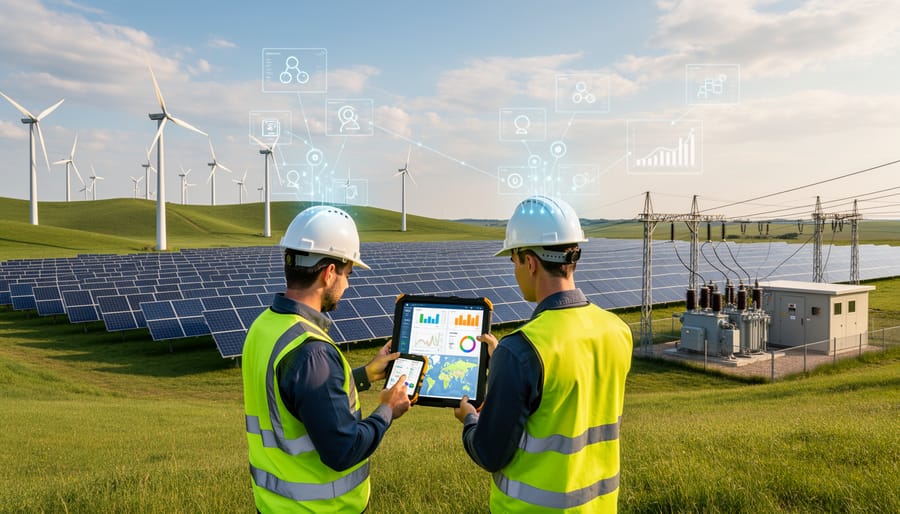
Two utilities have emerged as leaders in demonstrating 5G edge computing’s practical value at the grid edge, offering tangible proof of concept beyond theoretical benefits.
Southern California Edison launched a 5G edge computing pilot in 2024 across three substations serving high-penetration solar neighborhoods in Orange County. The utility deployed edge servers co-located with 5G small cells to manage over 4,000 residential solar systems and 800 battery installations in real time. The technical architecture processes voltage data, weather feeds, and inverter telemetry locally within 10 milliseconds, enabling automated volt-VAR optimization without round-trip communication to centralized data centers. During the pilot’s first year, SCE documented a 23% reduction in voltage violations during peak solar generation periods and cut the frequency of manual truck rolls for grid adjustments by 40%. The system successfully managed a severe cloud transient event in August 2025 when passing storm cells caused solar output to swing 2.1 megawatts in under 90 seconds, the edge computing platform automatically dispatched battery resources and adjusted voltage regulators fast enough to prevent customer impacts that would have occurred under the previous SCADA refresh cycle of four seconds.
In the UK, Scottish and Southern Electricity Networks partnered with Vodafone to deploy 5G edge computing across the Orkney Islands, a location with wind generation capacity exceeding local demand by 300%. The challenge was curtailment, wind farms frequently shut down because the subsea cable to mainland Scotland couldn’t handle excess power. SSEN’s solution processes wind forecasts, grid conditions, and flexible load data (including EV chargers and heat pumps) at island-based edge nodes connected via 5G. Machine learning algorithms running on edge servers coordinate 15-minute dispatch schedules for 600 controllable loads, matching renewable generation in near-real-time. Since deployment in early 2025, curtailment dropped from 28% to 11% of potential wind generation, adding £1.8 million in annual renewable revenue while improving energy sustainability metrics for the islands. The system handled Orkney’s record wind event in March 2026 without curtailment by orchestrating distributed loads with sub-second response times that traditional infrastructure couldn’t match.
Benefits Driving Adoption in the Energy Sector
The business case for 5G edge computing in the energy sector extends far beyond incremental improvements, it fundamentally reshapes what’s possible at the grid edge. Utilities and grid operators adopting this technology are seeing measurable gains in operational performance, cost efficiency, and their ability to manage increasingly complex, distributed energy systems.
The most transformative advantages stem from bringing computation and decision-making closer to where energy is generated, stored, and consumed. Traditional cloud-based systems introduce latency that’s unacceptable for time-critical grid operations; 5G edge computing slashes response times from hundreds of milliseconds to single-digit figures. For protective relaying, fault isolation, and automated switching during grid disturbances, this speed difference translates directly into reduced outage duration and equipment damage.
Key benefits driving rapid adoption across the energy sector include:
- Sub-10 millisecond latency enabling real-time protection and control of distributed energy resources
- Enhanced grid visibility through continuous monitoring of thousands of edge devices without overwhelming central systems
- Seamless renewable integration via instantaneous adjustments to solar and wind variability
- Reduced data transmission costs by processing information locally and sending only critical insights to central operations
- Improved system resilience through autonomous operation capabilities when communication with central facilities is disrupted
Beyond operational metrics, utilities are discovering new revenue opportunities. Dynamic pricing becomes practical when edge systems can respond to real-time conditions and communicate instantly with customer devices. Aggregated distributed energy resources can participate in wholesale markets with the coordination and speed that grid operators demand. Energy storage systems can optimize their charge-discharge cycles based on hyper-local conditions rather than broad regional signals.
For consumers, the benefits manifest as improved power quality, fewer and shorter outages, and access to demand response programs that actually work without manual intervention. Commercial and industrial customers gain unprecedented control over their energy use, with edge analytics identifying optimization opportunities that centralized systems would miss in the noise of aggregated data.
Challenges and Considerations for Deployment
Despite its transformative potential, deploying 5G edge computing across the energy grid isn’t a simple plug-and-play proposition. Utilities and grid operators face substantial hurdles that require strategic planning and often significant investment to overcome.
Infrastructure Investment and Economics
The upfront capital requirements present a formidable barrier. Building out 5G network coverage specifically for grid infrastructure demands dense antenna deployment, specialized equipment, and fiber backhaul connections that weren’t designed into legacy grid architectures. Edge computing nodes require physical installation, power supplies, cooling systems, and ongoing maintenance. For many utilities operating under rate-regulated business models, justifying these expenditures to regulators while demonstrating clear ratepayer benefits creates a complex approval process. Smaller municipal utilities and rural cooperatives face particularly steep challenges, as the per-customer cost in less dense service territories can be prohibitive.
Interoperability and Standards Gaps
The energy sector operates equipment with lifespans measured in decades, yet 5G and edge computing represent rapidly evolving technology domains. Ensuring new 5G edge systems can communicate seamlessly with existing SCADA infrastructure, smart meters from multiple vendors, and legacy grid control systems requires extensive integration work. Current standards for secure communication protocols, data formats, and control interfaces remain fragmented. Different vendors implement proprietary approaches that create lock-in risks and complicate multi-vendor deployments.
Cybersecurity in a Distributed Environment
Pushing computing and decision-making to thousands of edge locations dramatically expands the attack surface for potential cyber threats. Each edge node becomes a potential entry point that must be hardened, monitored, and maintained. Unlike centralized data centers with dedicated security teams, edge infrastructure often sits in substations, on utility poles, or in community facilities with minimal physical security. The real-time nature of grid control applications means security measures can’t introduce latency that undermines the performance advantages 5G edge computing provides. Balancing robust authentication, encryption, and intrusion detection with sub-millisecond response requirements demands sophisticated security architectures.
Workforce and Skills Requirements
Implementing these systems requires skills that bridge traditional electrical engineering, telecommunications, and modern IT domains. Many utilities face a workforce gap, needing personnel who understand both grid operations and advanced networking technologies, a combination not abundant in today’s labor market.
The Road Ahead: What’s Next for 5G Edge Computing in Energy
The 5G edge computing landscape is evolving rapidly, with 2026 marking a pivotal year for moving from proof-of-concept to commercial deployment in energy systems. Multiple utilities across North America, Europe, and Asia are expanding pilot programs into multi-site rollouts, testing everything from virtual power plant coordination to autonomous microgrid operations. These deployments are generating real performance data that will inform standardization efforts and best practices.
Standardization work is accelerating through organizations like the IEC and IEEE, which are developing protocols for interoperability between different vendors’ edge computing platforms and 5G network infrastructure. This standardization is crucial for utilities that need to avoid vendor lock-in and ensure long-term system compatibility. The focus is shifting from whether 5G edge computing works to how different implementations can communicate seamlessly.
The technology’s integration with eco-friendly alternatives like distributed solar, wind, and battery storage will intensify through 2030. Edge computing’s ability to manage the inherent variability of renewables at millisecond speeds positions it as essential infrastructure for grids targeting 80% or higher renewable penetration. Utilities are increasingly viewing 5G edge investments not as experimental technology but as necessary enablers of decarbonization commitments.
Looking beyond 2030, the convergence of 5G edge computing with artificial intelligence and digital twin technology promises even more sophisticated grid management capabilities. Edge nodes will run increasingly complex predictive models, enabling proactive rather than reactive grid operations. The question is no longer if this technology will transform the grid edge, but how quickly utilities can deploy it at scale to meet climate targets and reliability expectations.
Frequently Asked Questions
Implementing 5G edge computing at the grid edge raises practical questions for utilities, technology providers, and energy professionals evaluating this infrastructure investment. The following addresses the most common queries about deployment, security, and integration with existing systems.
How does 5G edge computing differ from traditional cloud computing for grid applications?
Edge computing processes data locally at or near the grid edge rather than sending it to distant cloud data centers, reducing latency from hundreds of milliseconds to under 10 milliseconds. This enables real-time control and decision-making that cloud architectures simply can’t support for time-critical grid operations like fault detection or frequency regulation.
What are the main security concerns with 5G edge computing in energy infrastructure?
The distributed nature of edge computing creates more potential entry points for cyber attacks compared to centralized systems, requiring robust encryption, network segmentation, and authentication at each edge node. However, localized processing also contains breaches more effectively, preventing a single compromised device from accessing the entire network.
How long does it take to deploy 5G edge computing across a utility’s service territory?
Full deployment typically requires three to seven years depending on territory size and existing infrastructure, with most utilities adopting a phased rollout that prioritizes critical substations and high-DER penetration areas first. Pilot programs usually run 12 to 18 months before broader implementation begins.
Can 5G edge computing work with legacy grid equipment and existing SCADA systems?
Yes, through protocol translators and edge gateways that bridge communication between modern 5G networks and older equipment using standards like DNP3 or Modbus. This allows utilities to modernize incrementally without replacing functional infrastructure, though some legacy devices may need communication modules added.
Cost considerations vary widely based on deployment scale and existing infrastructure. Initial investment includes 5G network infrastructure, edge computing hardware, and integration expenses, but operational savings from improved efficiency and reduced truck rolls often offset these within five to eight years. Many utilities pursue partnerships with telecommunications providers to share 5G network costs rather than building private networks from scratch.
The convergence of 5G networks and edge computing isn’t just another incremental upgrade to energy infrastructure. It represents a fundamental shift in how we manage, optimize, and decentralize power systems. As grids become increasingly complex with millions of distributed energy resources, the ability to process data and make decisions in milliseconds at the edge becomes essential rather than optional.
We’re witnessing the early stages of this transformation. Utilities piloting these systems are already seeing measurable improvements in grid stability, faster integration of renewables, and new capabilities for demand management. The technology addresses real operational challenges that have emerged as clean energy adoption accelerates.
What makes this convergence particularly significant is its timing. As nations commit to aggressive decarbonization targets, the grid edge is where those commitments translate into physical infrastructure. Solar panels, batteries, EV chargers, and smart buildings need intelligent coordination that centralized systems simply can’t provide at the required speed and scale. 5G edge computing creates the nervous system that makes this coordination possible.
The path forward involves continued collaboration between telecom providers, utilities, equipment manufacturers, and regulators. Standards will evolve, costs will decrease, and deployment will expand from pilot projects to widespread implementation.
For energy professionals, now is the time to engage with this technology directly. Whether through pilot programs, industry partnerships, or simply staying informed, understanding how 5G edge computing works will be crucial for anyone involved in building tomorrow’s energy systems.