
China commands the world’s largest renewable energy capacity, installing more wind and solar power in recent years than the rest of the planet combined. By the mid-2020s, the country accounts for nearly half of all new global renewable installations, a scale driven by aggressive state policy, plummeting technology costs, and an urgent need to reduce catastrophic air pollution and carbon emissions. For energy professionals and policy makers tracking the energy transition, understanding China’s renewable trajectory isn’t optional. It shapes global supply chains, sets technology price floors, and influences climate diplomacy worldwide.
The numbers tell a striking story. China’s renewable capacity additions have consistently exceeded 100 gigawatts annually, with solar and wind leading the charge. Provincial governments compete to host gigawatt-scale projects, and coastal regions have become testing grounds for offshore wind farms that rival small countries in output. Yet the picture isn’t without complexity. Grid integration challenges, curtailment rates in remote provinces, and the paradox of continued coal expansion alongside renewables reveal tensions between ambition and execution.
This article examines the full spectrum of China’s renewable installations: the policy architecture underpinning growth, real-world case studies from leading projects, expert perspectives on what’s working and what’s stalling, and the global ripple effects as Chinese manufacturers dominate solar panel and wind turbine markets. Whether you’re assessing investment opportunities, crafting energy policy, or simply trying to grasp the geopolitics of decarbonization, China’s renewable story offers essential lessons about speed, scale, and the friction points of industrial transformation.
The Scale of China’s Renewable Energy Dominance
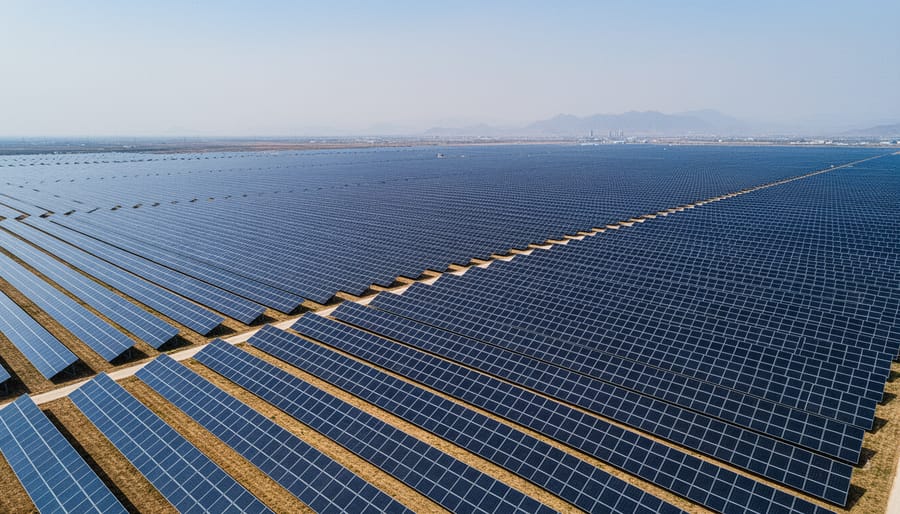
China’s dominance in renewable energy installations is not a matter of incremental progress, it’s a reshaping of the global energy landscape at unprecedented scale. As of 2026, China accounts for more than half of all new renewable energy capacity added worldwide, a lead that continues to widen year after year.
The numbers tell a remarkable story. China’s installed solar capacity has surged past 600 gigawatts (GW), representing roughly 40% of global solar installations. Wind power capacity exceeds 450 GW, with both onshore and offshore projects contributing to rapid expansion. Hydropower, long a cornerstone of China’s renewable portfolio, remains the world’s largest at approximately 420 GW. Together, these three technologies form a renewable energy base that dwarfs any other nation’s efforts.
| Technology Type | Installed Capacity (GW) | Share of Global Total |
|---|---|---|
| Solar | 600+ | ~40% |
| Wind (Onshore & Offshore) | 450+ | ~37% |
| Hydropower | 420 | ~28% |
Year-over-year growth rates reveal the acceleration behind these totals. China added approximately 180 GW of solar capacity in 2025 alone, more than the entire installed solar base of most countries. Wind installations grew by roughly 75 GW in the same period, with offshore wind emerging as a particularly dynamic segment. This pace means China installs more renewable capacity in a single year than entire continents manage over multiple years.
These figures matter profoundly for global climate goals. The International Energy Agency estimates that achieving net-zero emissions by mid-century requires tripling global renewable capacity by 2030. China’s installation trajectory accounts for a substantial portion of that necessary growth, making its renewable expansion essential rather than optional for planetary climate targets. Every gigawatt of solar or wind capacity China brings online displaces fossil fuel generation and demonstrates the technical and economic feasibility of eco-friendly alternatives at massive scale.
The scale also drives down costs globally through manufacturing economies of scale and technology learning curves, creating a feedback loop that accelerates renewable adoption beyond China’s borders.
Policy Drivers Behind China’s Renewable Boom
The Carbon Neutrality Pledge and Its Impact
In September 2020, President Xi Jinping announced China’s dual-carbon climate goals: peak carbon dioxide emissions before 2030 and achieve carbon neutrality by 2060. This pledge fundamentally reoriented China’s energy strategy, transforming renewable installations from an industrial policy tool into a climate imperative with binding timelines.
The 2030 peak target drove immediate action. China committed to installing over 1,200 GW of combined wind and solar capacity by 2030, requiring annual additions of roughly 100 to 120 GW, a pace that seemed ambitious in 2020 but which China has consistently met or exceeded since. Provincial governments received specific renewable capacity quotas tied to their carbon budgets, creating accountability mechanisms that translate national ambition into local execution.
The 2060 neutrality goal shaped longer-term planning. It justified massive grid infrastructure investments, accelerated research into green hydrogen and advanced energy storage, and prompted coal power plant retirement schedules. Financial institutions adjusted lending criteria to favor renewable projects, while permitting processes for wind and solar farms were streamlined to remove bureaucratic delays that once slowed installations by months or years.
Provincial Execution and Competition
China’s carbon neutrality pledge cascades down through a competitive federal structure where provincial governments vie for renewable energy leadership. Each province receives differentiated targets based on resource endowment, industrial capacity, and existing energy mix, but many deliberately overshoot national mandates to secure economic advantages and political recognition.
Inner Mongolia and Xinjiang, blessed with vast land and wind resources, have raced to become renewable powerhouses, often installing double their minimum quotas. Coastal provinces like Jiangsu and Guangdong leverage offshore wind potential and manufacturing clusters to claim technology leadership. This competition accelerates installations beyond central planning expectations. Provincial officials face performance evaluations partly based on renewable capacity additions, creating strong incentives to approve projects quickly and attract private investment.
The system isn’t without friction. Wealthier coastal provinces can afford aggressive installations, while inland regions struggle with financing and grid access. Provincial RPS implementation reveals significant variation in compliance rates and enforcement rigor. Some provinces game the system by counting planned capacity prematurely or negotiating easier benchmarks. Yet this decentralized competition generates rapid learning, cost reductions, and installation speeds that centralized mandates alone couldn’t achieve, making China’s renewable rollout more dynamic and regionally diverse than top-down targets suggest.
Technology and Manufacturing Advantages
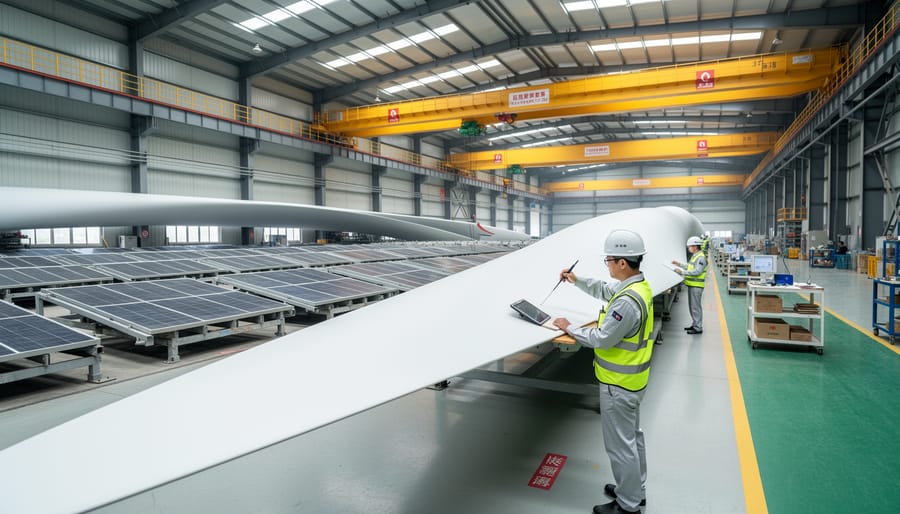
China’s renewable energy dominance rests on an unmatched manufacturing foundation that combines scale, vertical integration, and relentless cost reduction. The country controls over 80 percent of global solar panel production capacity and manufactures roughly half of the world’s wind turbines, a concentration that gives Chinese developers immediate access to equipment at prices competitors cannot match. This manufacturing muscle translates directly into faster, cheaper installations: when solar modules cost 30 to 40 percent less in China than in Europe or the United States, project economics shift dramatically in favour of rapid deployment.
The manufacturing advantages extend across multiple technologies and supply chain layers:
- Solar panel production capacity exceeding 600 gigawatts annually, far surpassing global installation demand
- Wind turbine technology leadership in both onshore and offshore platforms, with domestic manufacturers like Goldwind and Envision producing competitive multi-megawatt units
- Battery storage innovation through companies such as CATL and BYD, which dominate lithium-ion cell production for grid-scale and electric vehicle applications
- Rare earth element access and processing capabilities essential for permanent magnets in wind turbines and electric motors
- Integrated supply chains that connect polysilicon refining, wafer production, cell fabrication, and module assembly within domestic borders
Beyond raw production volume, Chinese manufacturers have driven innovation in solar cell efficiency, achieving commercial production of cells above 25 percent conversion rates and pioneering bifacial and PERC technologies at scale. China solar manufacturing has evolved from producing low-cost commodity panels to leading in next-generation technologies, including heterojunction and tandem cells that promise further efficiency gains.
The supply chain integration is equally critical. A single province like Jiangsu hosts companies producing silicon ingots, wafers, cells, modules, inverters, and mounting systems, reducing logistics costs and lead times. This clustering effect creates economies of scale that ripple through the entire value chain: when polysilicon prices drop due to oversupply, solar projects become more economical, spurring additional installations that further drive down balance-of-system costs.
China’s manufacturing ecosystem also benefits from supportive industrial policy that treats renewable equipment as strategic infrastructure. Local governments provide land, tax incentives, and preferential financing to renewable manufacturers, accelerating capacity expansion and technology upgrades. The result is a self-reinforcing cycle where manufacturing scale enables lower installation costs, which in turn justify further manufacturing investment and innovation.
Real-World Installation Projects: Case Studies
China’s renewable energy ambitions come to life in a series of landmark projects that showcase both engineering ambition and strategic execution. Three installations in particular demonstrate how the country is translating policy into physical infrastructure at unprecedented speed and scale.
The Kubuqi Solar Park in Inner Mongolia stands as one of the world’s largest photovoltaic installations, spanning more than 6,000 acres of former desert terrain. This project does double duty: generating 2,000 megawatts of solar power while simultaneously combating desertification through vegetation planted beneath and around the panels. The shade from the solar arrays reduces evaporation, allowing hardy grasses and shrubs to take root in soil that was previously barren. Local herders now graze sheep between panel rows, creating an integrated land-use model that generates income from both electricity and livestock. The technical achievement lies not just in the scale but in the grid connection infrastructure built to transmit power across 500 kilometers to population centers, overcoming the challenge of remote renewable resources.
Off the coast of Jiangsu Province, the Rudong Offshore Wind Farm represents China’s push into deeper waters and larger turbines. Completed in phases, the facility now operates 134 turbines with individual capacities reaching 11 megawatts, among the largest deployed anywhere. The project required specialized installation vessels capable of anchoring foundations in seabed depths exceeding 30 meters, along with subsea cable networks that withstand typhoon-force conditions common in the East China Sea. Developers coordinated with fishing communities to minimize disruption, designating turbine spacing that allows continued small-scale fishing activities. The farm’s proximity to Jiangsu’s industrial heartland eliminates the transmission losses that plague remote installations, feeding power directly into one of China’s most energy-hungry provincial grids.
In Qinghai Province, the Hainan Renewable Energy Base blends solar, wind, and hydropower across a high-altitude plateau, creating what officials describe as a clean energy laboratory. The hybrid design allows operators to balance output from different sources based on weather conditions and demand patterns. When wind speeds drop, solar arrays compensate during daylight hours, while existing hydroelectric capacity smooths supply during transition periods. Energy storage systems totaling 400 megawatt-hours handle short-term fluctuations, testing battery technologies at scale before wider deployment. The base serves as a proving ground for grid management software that will eventually coordinate renewable inputs across multiple provinces.
These projects share common threads: ambitious scale, integration of multiple technologies, and solutions tailored to specific geographic and economic contexts. They reveal an installation strategy that views renewable energy infrastructure as more than power generation, it’s environmental restoration, economic development, and technological innovation rolled into single initiatives.
Grid Integration and Infrastructure Challenges
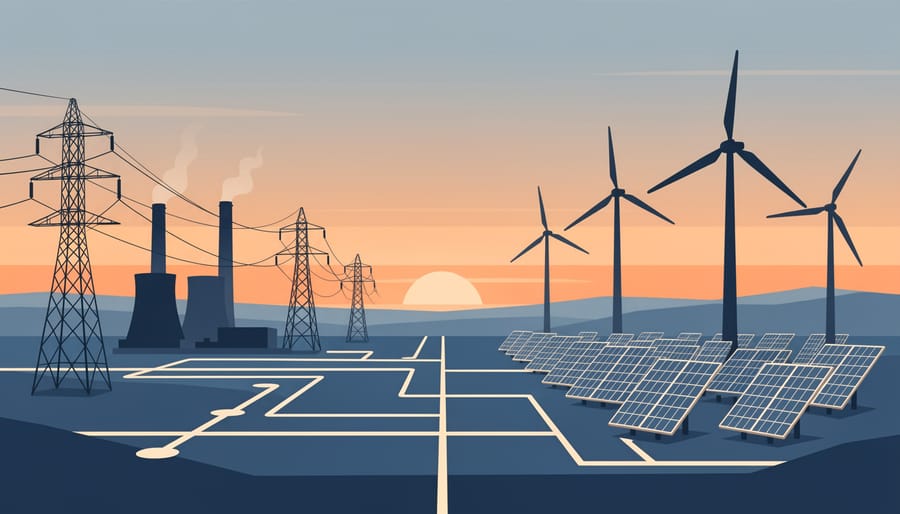
China’s explosive renewable capacity growth has forced a comprehensive overhaul of its power infrastructure. Adding hundreds of gigawatts of wind and solar annually creates technical strain that no grid was originally designed to handle.
Transmission lines present the first bottleneck. Most of China’s best renewable resources lie in the west and north, Inner Mongolia’s wind corridors, Qinghai’s solar-rich plateaus, while demand concentrates along the eastern coast. The country has responded by constructing ultra-high-voltage (UHV) transmission lines capable of moving gigawatts across thousands of kilometers with minimal loss. These UHV corridors now number over a dozen major routes, but construction lags behind installation pace. The mismatch means some wind farms sit idle, waiting for connection infrastructure.
Curtailment, the forced shutdown of renewable generators when the grid cannot absorb their output, remains a persistent issue despite improvements. In 2021, national wind curtailment rates exceeded 15% in some provinces; by 2026, improved dispatch systems and storage have reduced this to single digits nationally, though regional spikes still occur during low-demand periods. Solar curtailment follows similar patterns, particularly in provinces racing ahead of transmission upgrades.
Energy storage deployment has accelerated as the primary solution. China leads globally in battery storage installations, with pumped hydro providing bulk capacity and lithium-ion systems handling rapid response. Provincial mandates now require new renewable projects to include storage, typically 10-20% of generation capacity for two to four hours. This bundled approach addresses intermittency but adds cost and complexity.
Smart grid technology enables more sophisticated management. Advanced forecasting models predict wind and solar output hours ahead, allowing coal plants to ramp down proactively. Automated dispatch systems balance multiple generation sources in real time, prioritizing renewables when available. Demand-side management programs shift industrial loads to match renewable peaks, though implementation varies by region.
The transition from fossil-dominated grids requires coal plants to operate differently. Many now serve as flexible backup rather than baseload generators, cycling on and off to complement renewable variability. This cycling reduces efficiency and increases wear, creating economic pressure on coal operators even as solar reshaping the grid becomes the new normal.
Global Implications of China’s Renewable Leadership
China’s renewable energy dominance ripples far beyond its borders, reshaping how the world approaches clean energy transitions. The country’s massive production scale has fundamentally altered global economics: solar panel prices dropped by over 80% in the past decade, largely because Chinese manufacturers achieved unprecedented economies of scale. Wind turbine costs followed a similar trajectory. This cost collapse made renewable energy financially viable in regions that previously couldn’t afford the technology, accelerating installations from sub-Saharan Africa to Southeast Asia.
The export dimension proves equally significant. Chinese manufacturers now supply roughly 70% of global solar module demand and hold substantial market share in wind turbines. This creates dependency concerns in importing nations, particularly as geopolitical tensions rise. The United States and European Union have introduced domestic content requirements and manufacturing incentives to rebuild local supply chains, but matching China’s cost structure remains challenging without similar scale.
Technology transfer flows both ways, though not always smoothly. Joint ventures in developing markets often include knowledge-sharing arrangements, helping recipient countries build technical capacity. Yet intellectual property disputes persist, and some Western manufacturers argue that subsidized Chinese products undercut innovation incentives elsewhere.
Climate diplomacy gained a paradoxical element: China leads in renewable installations while remaining the world’s largest carbon emitter. This duality shapes international climate negotiations, where China positions itself as both a developing nation needing flexibility and a renewable energy superpower demonstrating leadership. The country’s willingness to share affordable technology strengthens its diplomatic influence in the Global South.
Competitive pressure has forced international manufacturers to specialize. Unable to compete on cost for standard products, companies in Europe and North America focus on premium efficiency, advanced materials, offshore wind expertise, or specialized applications. Some have relocated production to markets with favorable policy support.
The net effect? China’s installations created a global renewable energy industry accessible to more nations, but concentrated manufacturing power raises questions about supply chain resilience that will shape energy security debates for years ahead.
What’s Next: Future Installation Targets and Trends
China’s renewable energy trajectory points toward continued aggressive expansion, with national planning documents outlining ambitious capacity targets that extend well into the next decade. The country aims to install at least 1,200 GW of solar and wind capacity by 2030, more than double the 2025 baseline, as part of its broader commitment to energy sustainability and carbon neutrality goals.
Emerging technologies are reshaping where and how installations occur. Floating solar projects on reservoirs and coastal waters are gaining traction, combining power generation with water conservation benefits. These installations avoid land-use conflicts while tapping into regions with limited available space. Deep-water offshore wind farms, positioned 50 to 100 kilometers from shore, represent another frontier. Advances in floating turbine platforms and high-voltage transmission cables are making previously inaccessible wind resources economically viable.
Energy storage is moving from supporting role to central pillar. Battery installations are projected to grow five to tenfold by 2030, addressing the intermittency challenge that has constrained renewable utilization. Pumped hydro storage expansions, compressed air systems, and grid-scale lithium-ion facilities are all receiving accelerated investment.
Policy priorities are shifting from pure capacity additions toward system optimization. Recent planning emphasizes grid flexibility, demand-side management, and regional balancing rather than installation records alone. Provincial targets now include storage mandates alongside renewable capacity requirements, ensuring new installations contribute to grid stability rather than exacerbate curtailment.
Technology hybridization is emerging as a practical approach. Solar-wind-storage integrated bases that combine multiple generation sources with on-site storage are becoming standard in western provinces, smoothing output profiles and improving economics. These configurations represent the next phase beyond single-technology megaprojects.
Common Questions About China’s Renewable Energy Installations
How does China’s renewable capacity compare to other countries?
China’s installed renewable energy capacity exceeds that of the United States, European Union, and India combined. As of 2026, China accounts for roughly 40% of global renewable installations, with solar and wind capacity far surpassing any other nation.
What role does coal still play in China’s energy mix?
Coal remains a significant baseload energy source, supplying approximately 60% of China’s electricity generation despite rapid renewable growth. The coal versus renewables dynamic shows a gradual transition rather than an immediate phase-out, with new coal plants still being built as backup capacity while renewable installations accelerate.
Are China’s renewable installations economically sustainable?
Yes, the installations have become increasingly cost-competitive due to economies of scale and domestic manufacturing advantages. Solar and wind projects in China now achieve grid parity without subsidies in many regions, making continued expansion economically viable.
How do international partnerships factor into China’s renewable sector?
China exports renewable technology globally through Belt and Road Initiative projects and bilateral agreements, while also collaborating with European and American research institutions on innovation. These partnerships extend China’s influence in global energy markets and facilitate technology transfer.
Are environmental concerns addressed in renewable project planning?
Environmental impact assessments are required for large-scale installations, though enforcement varies by region. Projects increasingly consider land use, wildlife corridors, and ecosystem impacts, particularly for offshore wind farms and hydropower developments in sensitive areas.
These questions reflect the complexity readers encounter when evaluating China’s renewable surge. The installations represent both unprecedented scale and ongoing tensions between fossil fuel dependence and clean energy ambitions. Understanding that China’s approach balances economic pragmatism with long-term decarbonization goals helps frame the country’s renewable leadership within realistic constraints rather than through an idealized lens.
China’s position at the forefront of renewable energy installations isn’t simply about impressive statistics, it represents a fundamental shift in how the world’s largest energy consumer powers its economy. The scale and speed of installations across solar, wind, and hydropower sectors demonstrate that rapid energy transitions are achievable when policy commitment, manufacturing capacity, and market forces align.
The implications extend far beyond China’s borders. As Chinese installations drive down technology costs and prove integration solutions at unprecedented scale, they accelerate renewable adoption globally. Countries worldwide benefit from more affordable solar panels and wind turbines, while grid operators learn from China’s experiences managing high renewable penetration. This interconnection means China’s energy transition directly influences the pace of global decarbonization.
Challenges remain substantial. Grid infrastructure must continue evolving, storage solutions need further deployment, and balancing renewable growth with fossil fuel reduction requires sustained focus. Yet the trajectory points unmistakably forward. China’s renewable installations have already reshaped global energy markets and will continue defining the boundaries of what’s technically and economically possible.
The momentum built over the past decade suggests that renewable energy installations will keep accelerating, supported by technology improvements and strengthening climate commitments. China’s experience offers both blueprint and cautionary tale, demonstrating what coordinated action can achieve while highlighting the complexities of transforming energy systems at scale. For anyone tracking global sustainability progress, understanding China’s renewable journey isn’t optional; it’s essential.