
The renewable energy sector added over 2.3 million jobs globally in 2025, and that growth shows no sign of slowing. For professionals eyeing this expansion, online certification programs offer a fast track into solar installation, wind energy management, energy auditing, and grid modernization roles without the time and cost barriers of traditional degree programs. But with hundreds of courses flooding the market, distinguishing rigorous, employer-recognized credentials from glorified certificates of participation has become increasingly difficult.
Maria Chen discovered this challenge firsthand. After 12 years in fossil fuel operations, she enrolled in three different online renewable energy programs in early 2025, only to find that two carried little weight with hiring managers. The third, however, led directly to her current role as a solar project coordinator in Nevada. Her experience mirrors a broader pattern: certification value hinges on accreditation bodies, hands-on components, and industry partnerships that many programs advertise but few deliver.
This article examines what separates career-advancing certifications from expensive digital badges in the context of the energy transition in 2026. We’ll clarify the distinction between professional training certifications and renewable energy product certifications, which verify that electricity purchases come from renewable sources but don’t build career skills. Then we’ll provide frameworks for evaluating program quality, compare leading certification options across solar, wind, energy efficiency, and policy sectors, and share insights from both recent graduates and the companies hiring them.
Whether you’re pivoting from a related field or deepening existing renewable energy expertise, the right certification can compress years of career development into months. The wrong one wastes money and momentum. Here’s how to choose wisely.
The Two Paths: Professional Training vs. Product Certification
The phrase “renewable energy certification” carries two distinct meanings that often confuse newcomers to the sector. One path certifies people, training individuals to design, install, manage, or evaluate renewable energy systems. The other certifies products, verifying that electricity or renewable energy credits (RECs) meet specific environmental standards. Understanding this split matters because searching for certification programs can lead you to either career training or product verification systems, depending on which door you open.
- Professional Training Certifications
- Credentials that validate an individual’s knowledge and competence in renewable energy technologies, project management, or system design. Examples include the Renewable Energy Institute’s accredited courses and specialized programs from organizations like CIET focused on energy transition skills.
- Product/Energy Certifications
- Third-party verification systems that confirm renewable electricity products or RECs meet established environmental and tracking standards. Green-e® Energy certification, which has provided oversight for voluntary renewable electricity transactions for nearly three decades, operates across Canada, Chile, Taiwan, Singapore, and the United States as the leading example.
- Renewable Energy Credits (RECs)
- Tradable certificates representing the environmental attributes of one megawatt-hour of renewable electricity generation. Product certification programs establish criteria these credits must meet before being sold to consumers or businesses making renewable energy claims.
Professional certification programs prepare you to work in the renewable energy industry, whether you’re designing solar arrays, evaluating wind farm feasibility, or managing energy storage projects. These credentials signal to employers that you possess specific technical knowledge and can apply it in real-world scenarios. The Renewable Energy Institute offers accredited training courses online and in live virtual formats, while CIET provides capacity-building focused on decarbonization pathways.
Product certification serves the market’s integrity. When a utility offers a “100% renewable” electricity product or a corporation purchases RECs to offset emissions, third-party certifiers like Green-e® Energy verify those claims against documented standards. DNV similarly provides independent accredited certification services for renewable energy products and projects. These systems prevent greenwashing and give buyers confidence that their purchase genuinely supports renewable generation.
Both certification types strengthen the renewable energy ecosystem. Professional credentials expand the skilled workforce needed to build and operate clean energy infrastructure. Product certification maintains market trust and ensures that consumer dollars actually drive renewable development. As online access to professional training grows in 2026, more people can pursue credentials that were previously locked behind geographic or institutional barriers, but it helps to know which certification path matches your goal.
Who Needs Renewable Energy Credentials in 2026
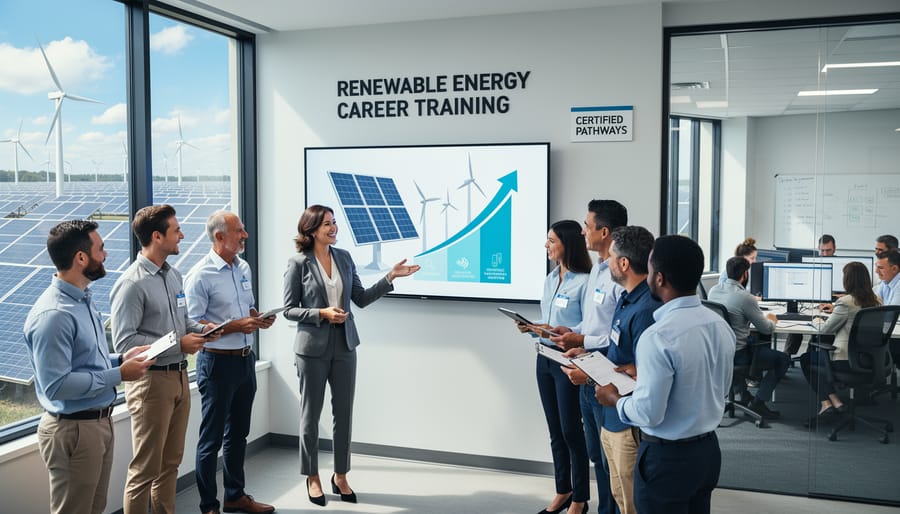
The renewable energy sector’s expansion in 2026 attracts professionals from remarkably different starting points, each pursuing certification for distinct strategic reasons. Understanding who pursues these credentials, and why, reveals how accessible online training is reshaping the industry’s talent pipeline.
**Career changers** represent perhaps the largest group seeking online renewable energy certifications. These individuals typically have transferable skills from adjacent industries but lack the specialized technical knowledge that renewable energy employers demand. A financial analyst from the oil and gas sector, for instance, might pursue certification in renewable energy project finance and lifecycle assessment to pivot toward evaluating solar farm investments. The online format allows them to maintain current employment while building new credentials, reducing the financial risk of career transition.
**Engineers already working in traditional energy or related fields** pursue certification to future-proof their expertise. A mechanical engineer designing HVAC systems, for example, completed an accredited program in renewable energy systems to expand into geothermal heat pump design and building-integrated solar applications. These professionals aren’t starting from scratch, they’re adding specialized knowledge that makes them more valuable as their industries shift toward decarbonization. The certification provides both technical depth and market credibility.
**Sustainability managers and corporate responsibility professionals** seek technical credentials to move beyond reporting and strategy into implementation. A sustainability coordinator at a manufacturing company might pursue certification to confidently specify renewable electricity products, understand REC markets, and evaluate suppliers, transforming from a communicator of sustainability goals into someone who can execute energy procurement decisions and verify claims with technical literacy.
**Policy professionals and government officials** increasingly need technical fluency to design effective renewable energy programs. Municipal planners, for instance, pursue certification to understand distributed solar economics, grid integration challenges, and energy storage feasibility when crafting local climate action plans.
**Entrepreneurs launching clean energy businesses** use certification to establish credibility with investors and customers. A consultant building a renewable energy advisory practice, for example, completed multiple certifications to demonstrate expertise that differentiated them in a competitive market while working from a remote location without access to traditional university programs.
Each audience shares a common thread: they need recognized credentials quickly and flexibly, making online certification uniquely suited to 2026’s diverse renewable energy workforce.

Leading Online Renewable Energy Training Programs
Accredited Institutional Programs
Accredited institutional programs offer the highest level of rigor and recognition for professionals entering renewable energy. The Renewable Energy Institute provides training courses that can be studied online or in live virtual format, combining theoretical foundations with practical applications. These courses cover core competencies from renewable resource assessment to system design, and they’re structured for working professionals who need flexible scheduling without sacrificing depth.
University-based certificates bring academic credentials to online learning. The Dalhousie Sustainable Energy SET program exemplifies how established universities have adapted their continuing education offerings for remote learners. This certificate covers energy efficiency, renewable technologies, and policy frameworks through a curriculum designed by faculty with research backgrounds in clean energy transitions.
| Provider | Format Options | Target Audience | Typical Duration |
|---|---|---|---|
| Renewable Energy Institute | Online, Live Virtual | Career changers, Engineers | 3-6 months |
| Dalhousie University | Online asynchronous | Technical professionals | 8-12 months |
| University programs (general) | Hybrid, Self-paced | Mid-career professionals | 6-18 months |
What sets these institutional programs apart is curriculum depth. Rather than survey-level overviews, they progress through interconnected modules that build technical competence systematically. A typical sequence starts with energy fundamentals and renewable resource characterization, then moves into technology-specific modules covering solar photovoltaics, wind power systems, energy storage, and emerging areas like grid edge innovation. Many programs integrate project economics, regulatory considerations, and environmental assessment to prepare graduates for real project development roles.
Delivery flexibility matters for adult learners balancing full-time work. The best institutional programs offer multiple entry points throughout the year, asynchronous content that accommodates different time zones, and optional live sessions for complex technical topics where real-time interaction helps. Some provide access to simulation software and virtual lab environments that let students model system performance or analyze grid integration scenarios from their own computers.
The value proposition comes down to credential recognition. Employers in utilities, engineering firms, and project developers understand what an institutional certificate represents in terms of foundational knowledge and time investment. A certificate from a recognized university or specialized renewable energy institute signals that a candidate has completed a structured learning path with assessments and demonstrated competencies, not just watched a few webinars.
Industry-Specific Certification Bodies
Beyond university-affiliated programs, a cluster of specialized certification bodies has emerged to serve distinct segments of the renewable energy workforce. These organizations deliver targeted, often accelerated training that aligns closely with industry hiring requirements and technical standards in 2026.
CIET stands out as a training and capacity-building institute focused specifically on energy transition and decarbonization. Rather than broad introductory courses, CIET’s programs address the operational challenges professionals face when implementing renewable projects, grid integration complexities, regulatory compliance in evolving markets, and stakeholder engagement strategies. Their curriculum reflects the reality that many renewable energy roles require not just technical knowledge but the ability to navigate institutional barriers and coordinate across engineering, policy, and community dimensions.
For hands-on technical skills, sector-specific certification providers offer training aligned with equipment manufacturers and installation standards. Solar PV installation certifications cover system sizing, electrical safety protocols, mounting techniques for diverse roof types, and commissioning procedures. Wind energy management programs delve into turbine operations, predictive maintenance using sensor data, and performance optimization across varying wind regimes. Energy storage system certifications have grown particularly relevant as battery installations proliferate; these courses address thermal management, battery management system configuration, and safe handling of lithium-ion and emerging chemistries.
Many of these specialized bodies maintain ties to industry associations or equipment suppliers, ensuring their curricula keep pace with rapid technology evolution. A solar certification earned in 2024 might not cover the bifacial panel optimization or integrated inverter-storage systems now standard in commercial installations. The best providers update content quarterly and incorporate real field data from recent projects.
The trade-off is narrow applicability. A certified solar installer gains immediately deployable skills but less strategic knowledge than a graduate of a broader energy systems program. For technicians, electricians transitioning into renewables, or project managers overseeing specific technology deployments, this focused approach often delivers faster return on investment. Completion times typically range from weeks to a few months, compared to six months or more for comprehensive certificate programs. This speed matters in a sector where project pipelines are expanding faster than the available skilled workforce, creating urgent demand for professionals who can start contributing within hiring cycles measured in weeks rather than years.
Understanding Green-e® and Product Certification Systems
While professional training programs equip individuals with renewable energy skills, a parallel certification ecosystem exists to verify the integrity of renewable energy products themselves. Green-e® Energy certification stands as the leading third-party certification in voluntary renewable electricity markets, providing oversight for transactions across Canada, Chile, Taiwan, Singapore, and the United States for nearly three decades. This system addresses a fundamental market challenge: how can businesses and consumers trust that the “green power” they purchase genuinely comes from renewable sources?
The Canada and U.S. Green-e v4.1 standard establishes specific criteria that renewable electricity must meet before appearing in a certified renewable energy product. This includes rigorous tracking of Renewable Energy Certificates (RECs), which represent the environmental attributes of one megawatt-hour of renewable electricity generation. Without credible verification, the market risks double-counting (where the same renewable megawatt-hour is sold to multiple buyers) or greenwashing claims disconnected from actual renewable generation. Green-e certification prevents these issues by auditing renewable energy suppliers, validating REC tracking systems, and ensuring transparent disclosure to end users.
The certification process involves annual verification that renewable electricity products meet environmental and consumer protection standards. Suppliers must document the generation source, vintage, and location of their renewable energy, submit to independent audits, and provide clear marketing claims. For corporate sustainability teams purchasing renewable energy to meet climate commitments, Green-e certification offers assurance that their investments genuinely support renewable generation rather than simply funding marketing narratives.
DNV provides another layer of independent accredited certification services for the renewable energy industry, focusing on technical standards for generation facilities and energy storage at scale projects. Their certification work spans project due diligence, performance validation, and compliance verification across solar, wind, and emerging technologies. While Green-e focuses on market transactions and product claims, DNV’s services validate the technical integrity and performance of the infrastructure producing renewable power.
Together, these certification systems create market trust and transparency. The over 25 years of Green-e verification history demonstrates how third-party oversight has matured voluntary renewable energy markets from niche offerings into mainstream corporate procurement tools. In 2026, as renewable electricity purchases accelerate and complex power purchase agreements become standard practice, robust product certification remains essential infrastructure supporting credible climate action.
What Makes Online Renewable Energy Training Effective
The shift from traditional classroom training to online renewable energy education represents more than a change in delivery method. It’s a fundamental reimagining of how technical skills are taught and applied. The most effective programs in 2026 don’t simply replicate lectures on a screen. They leverage digital tools to create learning experiences that, in some cases, surpass what’s possible in physical classrooms.
Virtual labs have become sophisticated enough to simulate complex energy systems. Learners can manipulate variables in solar array configurations, model wind turbine performance under different atmospheric conditions, or test energy storage scenarios involving safer batteries without accessing physical equipment. These simulations compress months of real-world observation into hours of focused experimentation, allowing students to see cause and effect relationships that would take years to encounter on job sites.
Live instructor interaction distinguishes quality programs from content dumps. Scheduled sessions with industry practitioners create accountability and allow for real-time problem-solving. When a solar engineer walks through a troubleshooting scenario during a virtual session, participants can ask about edge cases they’ve encountered in their own contexts. This immediacy bridges the gap between theoretical knowledge and practical application.
Peer collaboration platforms add unexpected value. Cohort-based programs create networks spanning continents, where a utility professional in Ontario discusses grid integration challenges with a project developer in Singapore. These exchanges expose learners to diverse regulatory environments, climate conditions, and market structures that a single instructor couldn’t adequately represent.
Capstone projects tied to actual industry challenges provide the credential’s real test. The strongest programs require learners to complete technical assessments, feasibility studies, or system designs that mirror work products they’ll produce professionally. A certificate holder who has already modeled a commercial solar installation or evaluated a community wind project enters the job market with demonstrable output, not just completed coursework.
The evolution from in-person to online training hasn’t diminished rigor. It has, however, removed geography as a barrier while maintaining the technical depth and industry relevance that employers demand.

Choosing the Right Certification for Your Goals
Selecting the right online renewable energy certification requires a strategic approach that aligns the program with your professional goals and current career stage. The range of options available in 2026 can be overwhelming, from university-based certificates to specialized solar industry credentials but a methodical evaluation framework simplifies the decision.
Start by verifying accreditation status. Programs like those offered by the Renewable Energy Institute carry formal accreditation, which signals that the curriculum meets recognized educational standards and that your credential will be taken seriously by employers. Independent organizations like DNV also provide certification services for the renewable industry, adding another layer of credibility to look for. Check whether the issuing body has industry standing or university affiliation, and avoid programs with vague or unverifiable credentials.
- Define your specific career objective, whether entering the field, upskilling in a technical area like wind energy management, or gaining strategic knowledge for policy work.
- Verify the program’s accreditation status through the provider’s website or direct inquiry, confirming the credentials are recognized in your target job market or region.
- Review the curriculum in detail to ensure it covers 2026-relevant technologies such as energy storage systems, grid integration, and hydrogen applications, not outdated content.
- Assess the time commitment against your schedule, noting whether the program offers flexible, self-paced modules or requires scheduled live sessions.
- Calculate total cost including tuition, materials, and any exam fees, then weigh this against potential salary increases or career advancement you expect.
- Research alumni outcomes by contacting the program directly for job placement data or searching LinkedIn for graduates to see their career trajectories.
Industry recognition matters as much as formal accreditation. Ask whether employers in your target sector value the certification. A program recognized by utilities, renewable project developers, or government agencies carries more weight than one unknown to hiring managers. Check job postings in your desired field to see which certifications appear frequently in requirements or preferences.
Curriculum relevance to 2026 technologies is critical. The renewable energy landscape evolves rapidly, with offshore wind, advanced battery storage, and green hydrogen gaining prominence. Programs that still emphasize outdated technologies or lack modules on emerging areas won’t position you competitively. Review syllabi for coverage of current policy frameworks, financing models, and technical standards that reflect today’s market realities.
Cost and time commitment vary dramatically. Some certificates require a few hundred dollars and complete in weeks, while comprehensive programs may cost several thousand and span six to twelve months. Balance your budget against the credential’s potential return on investment. Career changers often benefit from more intensive programs that provide deeper technical knowledge, while working professionals seeking to add credentials may prefer shorter, focused courses.
Finally, investigate tangible career outcomes. Contact program administrators for data on graduate employment rates, average salary increases, or job placement support. Speaking directly with alumni provides unfiltered insights into whether the certification delivered on its promises. Programs transparent about outcomes demonstrate confidence in their value.
Real-World Impact: From Certificate to Career
The career transformation stories emerging from online renewable energy certification in 2026 demonstrate how accessible training translates into tangible professional advancement across diverse backgrounds.
Marcus Chen spent fifteen years as a transmission engineer for a regional utility, watching his colleagues migrate toward grid modernization projects while he remained in traditional operations. After completing a six-month online certification in solar energy systems and grid integration through an accredited program, he transitioned into his utility’s distributed solar team as a project coordinator. Within eighteen months, he advanced to senior project manager overseeing utility-scale installations. His salary increased by 28 percent from his previous role, but the career satisfaction proved equally valuable. “The certification gave me the technical vocabulary and analytical frameworks to contribute meaningfully on day one,” Marcus explains. “I wasn’t just relearning my profession, I was applying two decades of grid experience to a technology I’d studied rigorously but remotely.”
Sarah Okonkwo’s pivot proved more dramatic. She worked eight years as a petroleum engineer in offshore oil extraction before recognizing the industry’s long-term trajectory. An intensive online program in offshore wind technology, which included virtual turbine simulations and remote monitoring system exercises, equipped her with transferable skills she hadn’t recognized initially. Structural analysis, marine logistics, project economics, the fundamentals crossed over more seamlessly than she’d anticipated. A Scottish offshore wind developer hired her as a technical specialist, valuing both her offshore experience and her newly-certified wind expertise. Her compensation remained comparable initially, but the professional pivot positioned her in a sector projecting 40 percent workforce growth over the next decade rather than one contracting steadily.
Tom Ramirez represents a third pathway. As an independent sustainability consultant advising mid-sized manufacturers, he struggled with credibility gaps when clients requested renewable energy procurement strategies. He lacked the technical depth to evaluate PPA structures or assess on-site generation feasibility. A four-month online certification in renewable energy project development, completed during evenings while maintaining his consulting practice, transformed his service offering. He now commands 35 percent higher fees for energy-focused engagements and has declined general sustainability work to specialize exclusively in renewable strategy. “Clients want someone who understands both the boardroom and the electrical room,” he notes. “The certification proved I’d invested in the technical side, not just the policy rhetoric.”
These trajectories share common elements: credentials that translated immediately into professional currency, online delivery that accommodated existing careers, and programs aligned with 2026’s technical realities rather than outdated curricula.

The barriers that once confined renewable energy careers to a privileged few, proximity to specialized institutions, expensive in-person training, inflexible scheduling, are crumbling in 2026. Online certification programs have fundamentally democratized access to this sector, allowing a utility engineer in rural Canada, a sustainability manager in Singapore, and a career changer in Chile to gain the same credible credentials without relocating or pausing their income. This shift isn’t just convenient; it’s essential for meeting the industry’s explosive demand for skilled professionals across geographies where renewable projects are multiplying faster than traditional training infrastructure can expand.
Yet accessibility alone doesn’t guarantee career success. The professionals who thrive are those who invest time in verifying accreditation, ensuring their chosen program aligns with industry-recognized standards, and selecting curricula that reflect the technical realities of 2026, whether that’s energy storage integration, grid modernization, or decarbonization strategies. A certificate from a reputable provider opens doors; one from an unrecognized source wastes time and money.
The outlook for certified renewable energy professionals remains remarkably optimistic. Governments worldwide are accelerating clean energy mandates, corporations are racing toward net-zero commitments, and project pipelines are stretching years into the future. Every offshore wind farm, utility-scale solar installation, and green hydrogen facility requires trained professionals to design, build, manage, and optimize operations.
As online education platforms continue evolving, incorporating more sophisticated simulations, real-time industry data, and collaborative global cohorts, the distance between a certificate and meaningful career advancement will only shrink. For anyone willing to commit to rigorous, accredited training, the renewable energy sector in 2026 offers not just a job, but a stake in reshaping how the world powers itself.