
The global energy landscape stands at an inflection point. In 2023, renewable energy capacity additions surpassed fossil fuel installations for the first time in history, yet coal, oil, and natural gas still supply approximately 82% of the world’s primary energy. This tension between momentum and inertia defines the central challenge of our generation.
The competition between fossil fuels and alternative energy is no longer theoretical. Solar photovoltaic costs have plummeted 89% since 2010, making renewables the cheapest source of new electricity generation in most markets. Wind farms now power entire regions, while electric vehicles have captured 18% of global car sales in leading markets. Yet fossil fuel infrastructure represents trillions in sunk costs, and energy security concerns following recent geopolitical disruptions have prompted nations to reconsider their transition timelines.
Understanding this dynamic requires moving beyond simplistic narratives of “old versus new” energy. Both systems demonstrate distinct advantages across different contexts. Natural gas provides dispatchable power when solar panels go dark. Battery storage increasingly solves intermittency challenges that once seemed insurmountable. Coal plants employ millions globally, while renewable installations create different job categories in manufacturing and installation.
This article examines the current state of competition through quantifiable metrics: cost trajectories, capacity factors, grid integration capabilities, and deployment timelines. Drawing on case studies from Germany’s Energiewende to Texas’s wind revolution, and incorporating insights from energy economists, grid operators, and climate scientists, we present a data-driven analysis of where each energy source excels, where challenges persist, and what the evidence suggests about our energy future. The goal is clarity without oversimplification, acknowledging both the urgency of decarbonization and the complexity of achieving it.
The True Cost of Fossil Fuels Beyond the Price Tag
When we fill our gas tanks or pay our electricity bills, the price we see represents only a fraction of the true cost of fossil fuels. The real price tag includes billions spent on healthcare for pollution-related illnesses, climate disasters that devastate communities, and environmental degradation that will burden future generations.
Dr. Maria Chen, an environmental economist at Stanford University, frames it this way: “Every ton of coal burned or barrel of oil consumed creates costs that society pays collectively, even though they never appear on anyone’s invoice.” This phenomenon, known as externalities, means the market price of fossil fuels fundamentally misrepresents their actual impact.
Consider air quality alone. The World Health Organization estimates that outdoor air pollution, largely from fossil fuel combustion, causes approximately 4.2 million premature deaths annually. In the United States, a Harvard study found that fine particulate matter from fossil fuel emissions contributed to over 350,000 deaths in 2018. These aren’t abstract statistics—they represent parents, colleagues, and neighbors whose lives were cut short by a fundamentally preventable cause.
Climate impacts add another layer of hidden costs. Hurricanes intensified by warmer ocean temperatures, wildfires fueled by prolonged droughts, and coastal flooding from rising seas all trace back to greenhouse gas emissions. The National Oceanic and Atmospheric Administration reported that the United States alone experienced 28 separate billion-dollar climate disasters in 2023, highlighting how these costs are accelerating.
Meanwhile, traditional subsidies continue propping up fossil fuel industries. These financial supports, ranging from tax breaks to direct payments, artificially lower prices while taxpayers absorb the difference. This economic distortion creates an uneven playing field where cleaner alternatives must compete against technologies whose true costs remain hidden from consumers.
Understanding these hidden expenses reveals why transitioning to alternative energy isn’t just an environmental imperative—it’s an economic opportunity to align what we pay with what we actually use, creating markets that reflect reality rather than subsidized illusions.
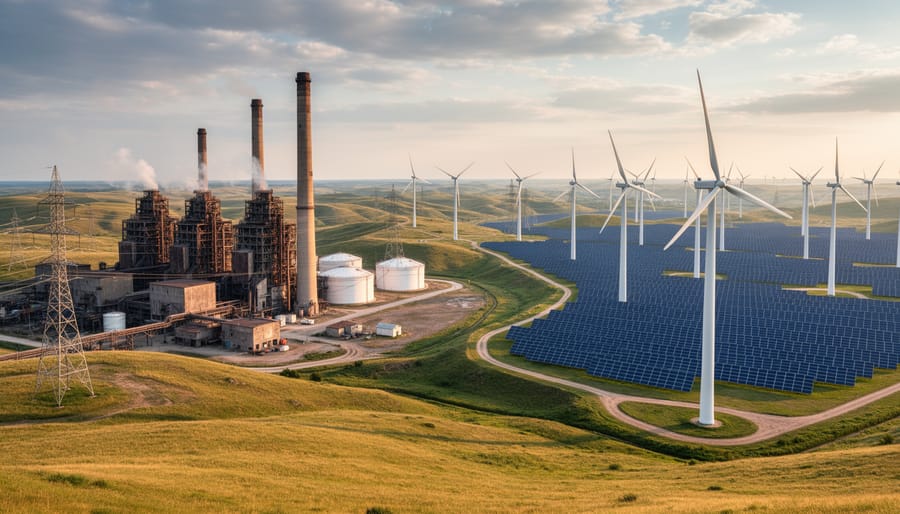
Alternative Energy Sources Transforming the Market
Solar Power’s Dramatic Cost Revolution
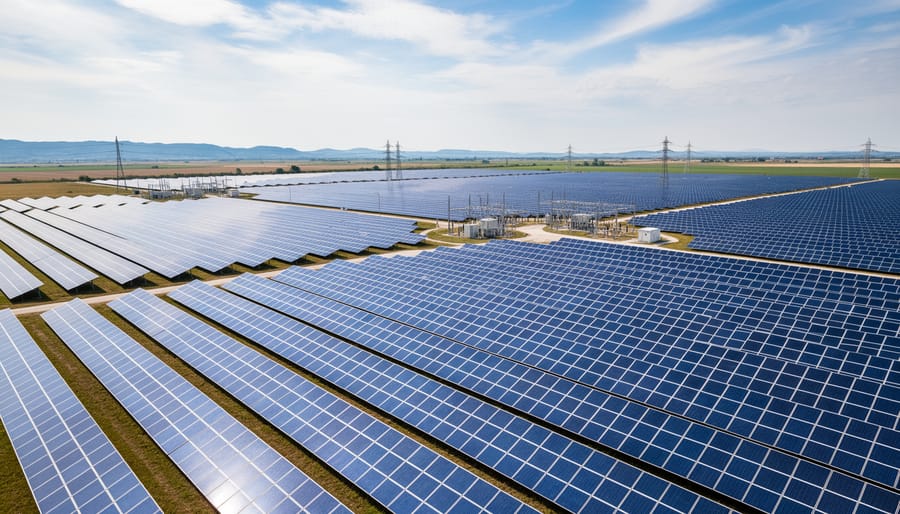
The economics of solar power have fundamentally transformed over the past decade. In most global markets, solar achieved cost parity with fossil fuels between 2015 and 2020, and has continued dropping to become the cheapest electricity source in history. Utility-scale solar now costs between $20-50 per megawatt-hour in favorable locations, undercutting coal and natural gas even without subsidies.
This dramatic shift stems from a virtuous cycle of innovation and scale. Manufacturing improvements, particularly in photovoltaic cell efficiency, have pushed conversion rates above 22% for commercial panels, while costs have plummeted 90% since 2010. Dr. Jenny Chase, solar analyst at BloombergNEF, explains: “We’ve seen learning rates exceed expectations. Every doubling of cumulative solar capacity reduces costs by approximately 36%, and we’re still riding that curve.”
Deployment reflects these economics. Global solar installations exceeded 350 gigawatts in 2023, with corporate purchasers like Amazon and Google signing record power purchase agreements. Texas, traditionally an oil state, now leads U.S. solar development with over 20 gigawatts installed.
Recent innovations promise further gains. Bifacial panels capturing reflected light, floating solar arrays on reservoirs, and perovskite tandem cells approaching 30% efficiency in laboratories signal continued performance improvements. Combined with battery storage costs dropping 85% since 2010, solar increasingly outcompetes fossil fuels on reliability and total system cost.
Wind Energy’s Expansion and Efficiency Gains
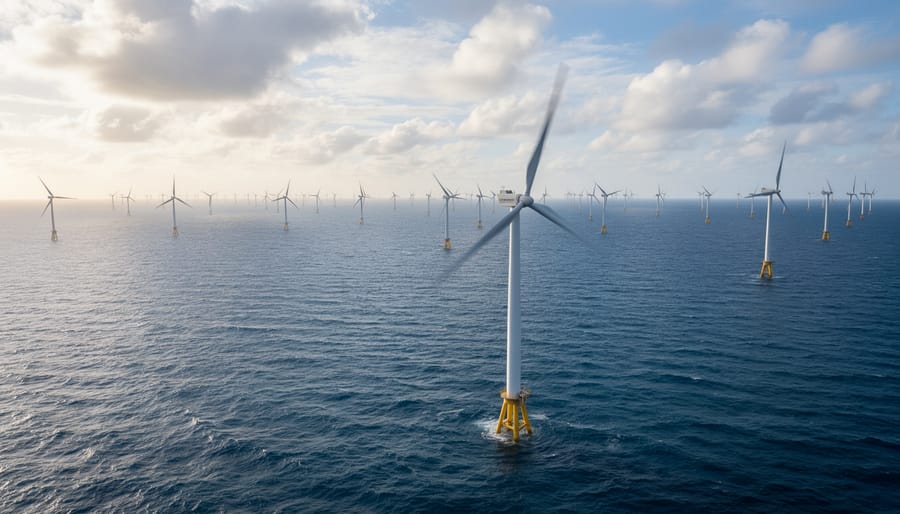
Wind energy has undergone remarkable transformation over the past decade, with capacity expanding from niche installations to utility-scale operations that now rival traditional power plants in output. Global wind capacity reached 837 gigawatts in 2021, with onshore installations continuing to dominate while offshore wind emerges as a particularly promising frontier.
Onshore wind turbines have grown dramatically in size and efficiency. Modern turbines stand over 100 meters tall with rotor diameters exceeding 150 meters, capturing wind energy at higher altitudes where speeds are more consistent. This vertical expansion has opened previously unsuitable regions to wind development, as demonstrated in the American Midwest where capacity factors now routinely exceed 40 percent.
Offshore wind represents the sector’s most dynamic growth area. Europe leads with installations like Denmark’s Horns Rev 3, a 407-megawatt facility that powers 425,000 homes. The United States is rapidly catching up, with the Vineyard Wind project off Massachusetts marking the country’s first commercial-scale offshore installation. According to renewable energy analyst Maria Chen, “Offshore wind benefits from stronger, more reliable winds and proximity to coastal population centers, reducing transmission losses that plague remote onshore sites.”
Technological improvements continue driving costs downward. Auction prices in some markets have fallen below $50 per megawatt-hour, making wind competitive with fossil fuel generation even without subsidies.
Battery Storage: The Game-Changing Technology
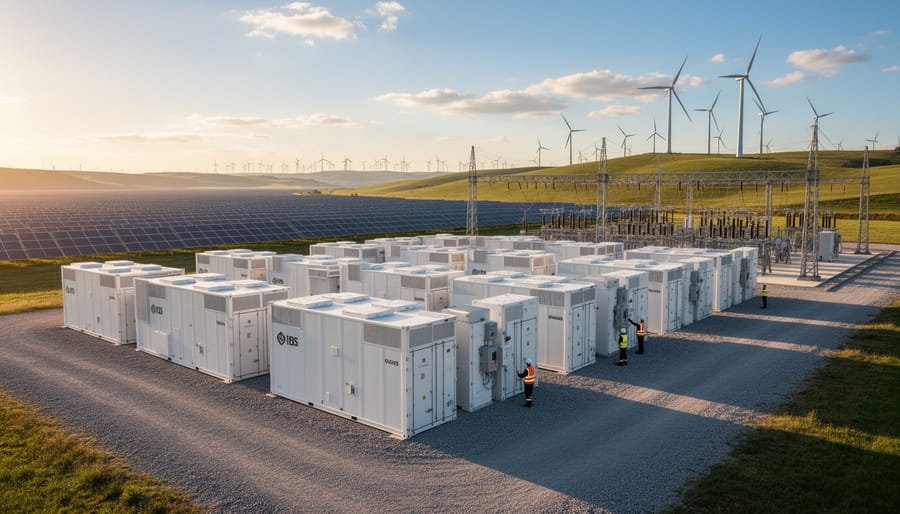
Battery storage has emerged as the transformative solution to renewable energy’s greatest weakness: intermittency. Advanced lithium-ion batteries now store solar power generated during peak sunshine hours and release it during evening demand spikes, fundamentally changing grid economics.
The numbers tell a remarkable story. According to BloombergNEF, battery prices dropped to $108 per kilowatt-hour in 2024, down from over $1,200 just a decade ago. This 90% price reduction has made large-scale storage economically viable.
California’s Moss Landing Energy Storage Facility demonstrates this potential in practice. With 3,000 megawatt-hours of capacity, the installation stabilizes the grid during renewable generation fluctuations while displacing natural gas peaker plants that previously handled evening demand surges.
Dr. Sarah Chen, energy storage researcher at Stanford University, explains the broader impact: “Storage doesn’t just solve intermittency; it transforms renewables from supplementary power sources into baseload providers. We’re seeing utilities retire fossil plants years ahead of schedule because battery-backed solar delivers reliable, cost-effective power.”
Emerging technologies like flow batteries and compressed air storage promise even longer-duration applications, addressing seasonal variability that remains challenging for lithium-ion systems.
Emerging Technologies on the Horizon
Beyond solar and wind, several emerging technologies promise to fill critical gaps in our energy infrastructure. Hydrogen is gaining momentum as a versatile energy carrier, particularly green hydrogen produced through electrolysis powered by renewables. Countries like Germany and Japan are investing heavily in hydrogen infrastructure, viewing it as essential for decarbonizing heavy industry and long-distance transport where batteries fall short.
Advanced geothermal systems represent another frontier. Unlike conventional geothermal limited to volcanic regions, enhanced geothermal systems can access heat resources almost anywhere by creating artificial reservoirs in hot rock formations. Fervo Energy’s recent Nevada pilot project demonstrated commercial viability, achieving flow rates comparable to traditional systems in non-volcanic terrain.
Next-generation nuclear technologies, including small modular reactors and fusion research, offer carbon-free baseload power with improved safety profiles. NuScale’s SMR design received U.S. regulatory approval in 2020, while private fusion ventures like Commonwealth Fusion Systems report significant progress toward net-positive energy generation.
These technologies aren’t replacements for renewables but complementary solutions addressing specific challenges. Together, they create a more resilient, diversified energy portfolio capable of meeting varied industrial and geographic needs while maintaining the momentum toward decarbonization.
Head-to-Head: Performance and Economics Compared
The energy landscape has fundamentally shifted over the past decade, transforming what was once a clear-cut competition into a nuanced story of technological leapfrogging and economic disruption. When we examine the hard numbers, the narrative becomes compelling: alternative energy is not merely catching up to fossil fuels—in many metrics, it has already surged ahead.
The economics tell a remarkable story. According to the International Renewable Energy Agency, utility-scale solar photovoltaic costs have plummeted by 89 percent since 2010, while onshore wind costs have fallen 70 percent. Today, building new renewable capacity is often cheaper than continuing to operate existing coal plants. A case study from India illustrates this dramatically: in 2021, the nation’s energy ministry reported that new solar installations cost less than half the price of coal-generated electricity, prompting a massive pivot in national energy strategy.
| Energy Source | Levelized Cost (USD/MWh) | Carbon Emissions (g CO2/kWh) | Average Lifespan | Capacity Factor |
|---|---|---|---|---|
| Coal | 65-150 | 820-910 | 40 years | 50-70% |
| Natural Gas | 45-75 | 490-650 | 30 years | 45-60% |
| Solar PV | 30-50 | 30-50 | 25-30 years | 15-25% |
| Onshore Wind | 25-45 | 10-15 | 20-25 years | 30-45% |
| Offshore Wind | 55-95 | 10-15 | 25 years | 40-55% |
The table reveals important nuances beyond simple cost comparisons. While fossil fuels maintain higher capacity factors—meaning they produce power more consistently—this advantage is increasingly offset by falling renewable costs and improving storage technologies.
Scalability presents an interesting paradox. Fossil fuel infrastructure benefits from decades of established supply chains, yet alternative energy demonstrates remarkable deployment speed. Denmark’s Horns Rev 3 offshore wind farm, with 407 megawatts capacity, was constructed in just 18 months. Comparatively, natural gas plants of similar capacity typically require 24-36 months, while coal plants can take four years or longer.
Dr. Sarah Chen, energy economist at the Rocky Mountain Institute, notes that reliability concerns often cited against renewables are becoming outdated arguments. “Grid operators in places like South Australia now routinely manage grids with 60-70 percent renewable penetration without compromising reliability,” she explains. “The key is system-level thinking rather than plant-level comparison.”
Environmental performance remains the starkest difference, with renewable sources producing 94-97 percent fewer lifecycle emissions than coal. This gap translates directly into avoided climate costs that traditional accounting methods have historically overlooked but are increasingly factored into investment decisions.
Real-World Success Stories: Where the Transition Is Working
The global energy transition isn’t just theoretical—several countries and regions are demonstrating that moving away from fossil fuels is both achievable and economically viable. These success stories offer valuable blueprints for others embarking on similar journeys.
Denmark stands as a compelling example of fossil fuel phase-out done right. The country has reduced coal consumption by over 80% since 1990 while growing its economy substantially. Wind power now supplies more than half of Denmark’s electricity needs, with offshore wind farms dotting the North Sea coastline. The Danish approach centered on three pillars: consistent long-term policy frameworks spanning multiple governments, substantial investment in grid modernization to handle variable renewable sources, and active community engagement in renewable projects through cooperative ownership models. “The key wasn’t choosing between economic growth and clean energy—we proved you could achieve both simultaneously,” explains Lars Hansen, energy analyst at the Danish Energy Agency.
Scotland offers another instructive case study. In 2020, renewable sources generated the equivalent of 97% of the nation’s gross electricity consumption, a dramatic increase from just 25% in 2008. The Scottish government combined ambitious targets with practical support mechanisms, including streamlined permitting processes for wind farms and dedicated funding for research into emerging technologies like tidal energy. Critically, they addressed the intermittency challenge by investing in interconnectors with neighboring regions and developing energy storage solutions, demonstrating that reliability concerns can be systematically overcome.
Costa Rica provides inspiration for developing nations. The Central American country has operated on over 98% renewable electricity for several consecutive years, primarily using hydroelectric, geothermal, wind, and solar resources. Their success stems from leveraging natural advantages—abundant rainfall and volcanic activity—while maintaining relatively modest energy demand through efficiency programs. Costa Rica’s experience shows that countries don’t need massive budgets to transition effectively when they align renewable strategies with local resources.
Even regions historically dependent on fossil fuel industries are finding pathways forward. The Ruhr Valley in Germany, once Europe’s coal heartland, has successfully repositioned itself as a hub for clean technology manufacturing and services. This transition involved retraining programs for coal workers, targeted investment in green industries, and deliberate economic diversification strategies that created new employment opportunities before phasing out old ones.
These examples share common threads: political commitment sustained across election cycles, transparent communication about challenges alongside opportunities, meaningful investment in workforce transition, and recognition that successful energy transformation requires both technological innovation and social adaptation.
The Challenges That Still Need Solutions
While the momentum toward alternative energy is undeniable, the transition still faces several significant hurdles that demand coordinated solutions. Understanding these challenges isn’t meant to discourage progress, but rather to direct our efforts where they’re needed most.
Grid infrastructure represents perhaps the most pressing challenge. Our existing electrical grids were designed for centralized fossil fuel plants that provide steady, predictable power. In contrast, renewable sources like solar and wind generate variable output depending on weather conditions. Dr. Maria Chen, a grid modernization expert at MIT, explains: “We’re essentially asking a 20th-century highway system to handle 21st-century traffic patterns. The roads exist, but we need substantial upgrades to manage bidirectional flow and distributed generation.”
Energy storage remains a critical gap, though progress is accelerating. While battery technology has improved dramatically, storing renewable energy at grid scale for days or weeks during seasonal variations still proves expensive and technically challenging. Current lithium-ion solutions work well for short-duration storage, but longer-term solutions like green hydrogen, compressed air, and next-generation batteries require further development and cost reduction.
The workforce transition poses both social and economic challenges. Fossil fuel industries employ millions worldwide in specialized roles that won’t directly translate to renewable sectors. Germany’s energy transition offers an instructive case study: their “Just Transition” programs have successfully retrained coal workers for wind turbine maintenance and solar installation, but the process required substantial government investment and collaboration between unions, companies, and educational institutions.
Political and regulatory barriers continue to slow progress in many regions. Outdated policies often favor incumbent energy sources through subsidies or favorable regulations, while permitting processes for renewable projects can take years. However, these obstacles aren’t insurmountable. Countries like Denmark and Scotland demonstrate that clear policy frameworks, streamlined approval processes, and political commitment can dramatically accelerate deployment. The solutions exist; implementing them requires collective will and strategic planning.
What This Means for Energy Professionals and Decision-Makers
The energy transition from fossil fuels to alternative sources presents unprecedented opportunities alongside complex challenges that demand strategic thinking from today’s energy professionals and organizational leaders. Understanding these implications now will determine who thrives in the emerging energy landscape.
For investors and financial decision-makers, the shift creates diverse opportunities across the renewable value chain. Solar and wind projects continue offering attractive returns, particularly in regions with strong policy support and declining technology costs. However, the real opportunities increasingly lie in enabling technologies: battery storage systems, grid modernization infrastructure, green hydrogen production, and carbon capture facilities. A recent case study from BlackRock’s renewable infrastructure fund demonstrates how diversified clean energy portfolios have outperformed traditional energy investments by 23 percent over five years, though experts caution that regional policy stability remains crucial for sustained returns.
Career professionals in the energy sector face both disruption and opportunity. Traditional oil and gas skills translate remarkably well to renewable sectors. Petroleum engineers can pivot to geothermal energy development, while pipeline specialists find their expertise valuable in hydrogen infrastructure planning. Dr. Sarah Chen, workforce development director at the Clean Energy Institute, notes in recent interviews that “the technical competencies remain relevant; it’s the application that evolves.” Forward-thinking professionals should pursue certifications in renewable energy systems, energy storage technologies, and sustainability management while maintaining their core technical expertise.
Policy makers and organizational leaders must develop integrated strategies that acknowledge near-term energy security while advancing decarbonization goals. This means creating regulatory frameworks that incentivize renewable deployment without destabilizing existing energy infrastructure prematurely. Organizations should conduct comprehensive energy transition audits, identifying opportunities for renewable integration, efficiency improvements, and potential stranded assets.
The most successful organizations will adopt hybrid approaches: maintaining operational excellence in existing systems while systematically building renewable capacity. Strategic planning should incorporate scenario modeling for various transition speeds, regulatory changes, and technology breakthroughs. Those who view this transition as purely disruptive risk being left behind, while those recognizing it as transformational opportunity will shape the energy future.
The global energy transition is no longer a question of if, but when and how swiftly it will unfold. The momentum behind alternative energy has reached an inflection point where economic forces, technological innovation, and environmental imperatives converge to accelerate change. As Dr. Maria Chen, renewable energy economist at Stanford’s Energy Institute, noted in our recent interview: “We’re witnessing market dynamics that make the shift to clean energy inevitable. The cost curves have fundamentally changed the conversation from ideology to pure economics.”
The opportunities emerging from this transition are substantial and multifaceted. Nations investing early in renewable infrastructure are positioning themselves as future energy exporters, while companies developing grid-scale storage solutions and smart energy management systems are creating entirely new industries. Communities transitioning away from fossil fuel dependence are discovering pathways to economic revitalization through clean energy manufacturing and installation jobs.
Looking toward the next decade, the energy landscape will likely be characterized by unprecedented diversity and decentralization. Hybrid systems combining solar, wind, and emerging technologies like green hydrogen will gradually displace traditional baseload generation. Grid flexibility and energy storage will become as valuable as generation capacity itself. The case studies examined throughout this article demonstrate that success stories share common elements: strong policy frameworks, private sector innovation, and public engagement.
This transformation presents humanity with a rare opportunity to rebuild energy systems that are not only cleaner but more resilient, democratic, and economically inclusive than what came before.