
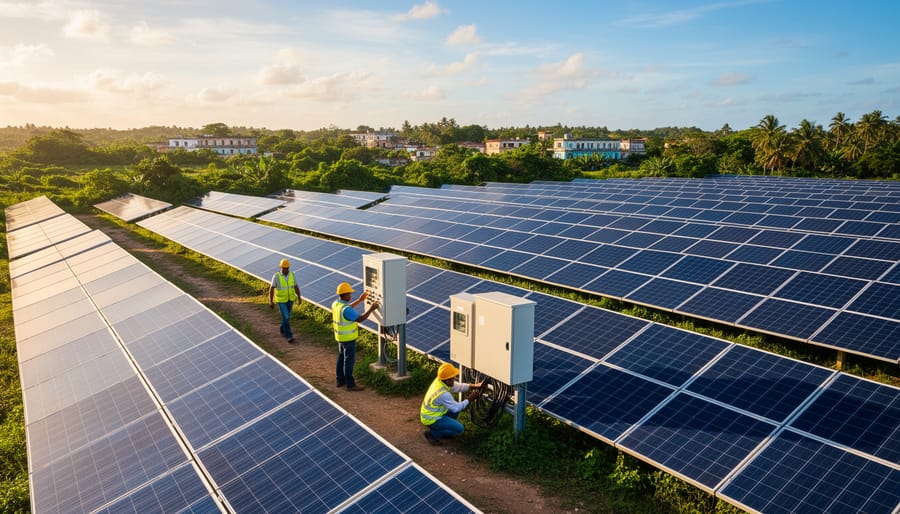
Cuba is installing solar panels at a pace that would have seemed impossible just five years ago. The island nation, long constrained by fuel shortages and an aging electrical grid, has added over 300 megawatts of solar capacity since 2022 alone. This represents a fundamental shift in how the country generates power, moving away from imported fossil fuels toward homegrown renewable energy.
The transformation didn’t happen by accident. Persistent blackouts, worsening economic pressures, and limited access to foreign oil have forced Cuba’s hand. What began as necessity, however, has evolved into opportunity. Government officials now speak of reaching 24% renewable energy by 2030, with solar leading the charge. Dozens of solar parks have sprouted across the countryside, from Pinar del Río to Santiago de Cuba, each one chipping away at the nation’s dependence on diesel generators and Venezuelan crude.
This mirrors a broader energy race shift happening globally, but Cuba’s story carries unique weight. The country is proving that even nations facing severe economic constraints can pivot toward clean energy when the political will exists.
Dr. María Fernández, an energy analyst at the University of Havana, puts it simply: “We had no choice but to innovate. That pressure created momentum.”
The implications extend beyond Cuba’s shores. Other Caribbean nations watching this experiment closely could follow suit, potentially reshaping the region’s energy landscape. The question isn’t whether Cuba can maintain this trajectory, but how quickly other island economies will join them.
Cuba’s Solar Power Revolution: From Crisis to Opportunity
The Energy Crisis That Sparked Change
Cuba’s electricity grid was in free fall by late 2021. Rolling blackouts stretched 12 hours a day in some provinces, leaving hospitals without power and homes sweltering in tropical heat. The root cause wasn’t a single failure but a converging crisis: Venezuela’s drastically reduced oil shipments, decades of deferred maintenance on Soviet-era power plants, and a fuel import bill the country simply couldn’t afford. When Hurricane Ian battered western Cuba in September 2022, the fragile system collapsed entirely, plunging the island into a nationwide blackout that lasted days.
The aging thermoelectric plants, some operational since the 1960s, broke down with alarming frequency. Spare parts were scarce, and the fuel to run them even scarcer. According to Global Solar Power Tracker data Cuba’s conventional generation capacity had degraded to the point where routine outages became the norm rather than the exception. Citizens adapted by stockpiling candles and ice, but industries ground to a halt, threatening what remained of the economy.
This wasn’t just an inconvenience. It was an existential threat to basic services and social stability. The government faced a stark choice: continue pouring scarce foreign currency into imported diesel or pivot decisively toward an energy source Cuba has in abundance, sunshine. The crisis made solar not just attractive but essential, transforming what might have been a gradual transition into an urgent revolution.
Strategic Solar Deployment Across the Island
Cuba’s solar deployment strategy combines massive utility-scale installations with thousands of smaller distributed systems, creating a multi-layered energy infrastructure across the island. The government has prioritized 33 solar parks distributed across all 15 provinces, with concentrations in eastern regions like Guantánamo and Santiago de Cuba where grid vulnerability has been most acute. These parks range from 2 to 50 megawatts each, strategically positioned near population centers to reduce transmission losses while avoiding prime agricultural land.
Simultaneously, Cuba is installing rooftop solar arrays on schools, hospitals, hotels, and government buildings in a parallel distributed generation push. This dual approach serves both immediate energy security needs and long-term grid resilience. Technical specifications favor straightforward, maintainable systems: crystalline silicon panels from multiple international suppliers, basic inverter technology, and essential components like solar charge controller units for battery storage integration where implemented.
The deployment follows a phased timeline prioritizing areas experiencing the most severe blackouts. Eastern provinces received installations first, with expansion moving westward toward Havana. Rural electrification projects are incorporating solar mini-grids in communities previously dependent on diesel generators or without reliable grid access. This geographic distribution strategy transforms Cuba’s energy landscape from a centralized, vulnerable system into a more resilient, decentralized network capable of maintaining power during grid disturbances.
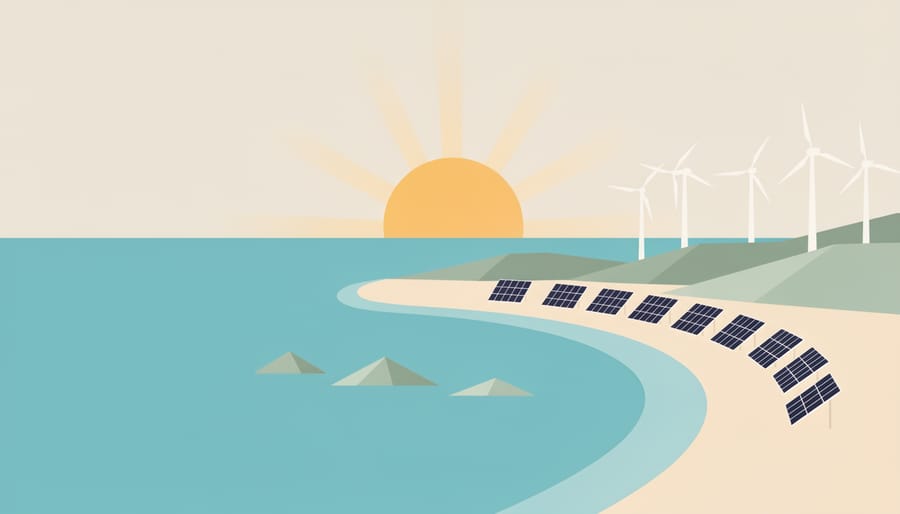
Caribbean Nations Watch and Follow: Regional Momentum Builds
Shared Challenges: Why the Caribbean is Ripe for Solar
Caribbean nations share a web of interconnected energy vulnerabilities that make solar power not merely attractive but essential. Most islands still rely on imported diesel for 80-90% of electricity generation, locking them into volatile global fuel markets. When oil prices spike, utility costs surge, Jamaica, Barbados, and the Dominican Republic routinely face electricity rates above 30 cents per kilowatt-hour, roughly triple the U.S. average. These costs drain national budgets and burden households already struggling with the economic impacts of tourism volatility.
Climate change amplifies the urgency. Caribbean islands sit directly in hurricane corridors, and strengthening storms repeatedly devastate centralized power infrastructure built around coastal diesel plants. After Hurricane Maria, Puerto Rico’s grid collapsed for nearly a year. Rising sea levels threaten the very facilities that produce power, while droughts reduce hydroelectric capacity in nations like Haiti and Jamaica that depend on it. The region needs resilient, distributed energy systems that can withstand and recover from extreme weather.
Yet the same geography that makes these islands climate-vulnerable also blesses them with extraordinary solar potential. The Caribbean averages over 2,800 hours of sunshine annually, more than enough to meet current electricity demand several times over. Cuba’s pivot demonstrates what becomes possible when necessity forces action: a resource that’s abundant, local, and increasingly affordable can replace expensive, imported fuel. Other nations are watching closely because they face identical challenges and hold the same natural advantage.
Regional Cooperation and Knowledge Transfer
Cuba’s experience hasn’t happened in isolation. The Caribbean Community (CARICOM) established the Centre for Renewable Energy and Energy Efficiency in 2015, but the last two years have seen unprecedented activity in technical knowledge sharing. Engineers from Jamaica, Barbados, and Trinidad visited Cuban solar installations in early 2024, documenting implementation strategies that don’t require deep capital reserves. These exchanges focus on practical challenges: how Cuba adapted Chinese-manufactured panels to harsh salt-air conditions, which mounting systems withstand hurricane-force winds, and how technicians trained local communities to handle basic maintenance.
The Organization of American States launched a Caribbean Solar Accelerator program in late 2023, explicitly referencing Cuba’s rapid deployment as proof that island states can move faster than previously assumed. This framework connects electrical utilities across twelve nations through quarterly virtual forums where grid managers troubleshoot integration challenges in real time. When Dominica installed its largest solar array last October, Cuban engineers provided remote consultation on voltage regulation issues that had stumped local teams for weeks.
Financing remains the sticking point, but Cuba’s model of mobilizing domestic labour and accepting equipment from multiple international sources has inspired creative approaches elsewhere. The Eastern Caribbean Energy Labelling Programme now includes a Cuba-developed certification standard for solar installers, recognizing that the island trained over 400 technicians in eighteen months using minimal external funding. Several smaller nations are replicating Cuba’s vocational training curriculum, translated into English and adapted for different regulatory environments. The knowledge flows both ways: Cuban utilities are studying Barbados’ smart-grid software and Jamaica’s community solar ownership structures.
Expert Perspectives: What Cuba’s Transformation Means for Solar Power Advancements
Dr. Maria Gonzalez, who has tracked Caribbean energy transitions for two decades at the Inter-American Development Bank, describes Cuba’s solar push as “a watershed moment for island nations globally.” She points to three factors that make this transformation particularly significant: the speed of deployment despite economic constraints, the integration of distributed and utility-scale systems simultaneously, and the demonstration that energy security concerns can accelerate renewable adoption faster than climate commitments alone.
The technological innovations emerging from Cuba’s experience are drawing attention from solar developers worldwide. Engineers are adapting standard solar equipment to function reliably in hurricane-prone environments with limited maintenance infrastructure. “Cuba is essentially beta-testing resilient solar designs that small island nations desperately need,” explains James Chen, a solar technology consultant who has worked across the Caribbean. The integration of safer batteries with solar installations represents another crucial advancement, as traditional lithium-ion systems posed fire risks in Cuba’s hot climate with inconsistent grid support.
Financing models developed for Cuba’s solar expansion are breaking new ground for resource-constrained environments. Ricardo Amado, an energy finance specialist, notes that Cuba has pioneered approaches combining state investment, bilateral partnerships, and innovative equipment leasing arrangements that avoid the conventional project finance structures requiring international bank participation. “Other developing nations are studying these models closely because they demonstrate pathways around traditional financing barriers,” he says.
The implications extend beyond the Caribbean. Cuba’s transformation shows that countries facing economic isolation can still achieve rapid renewable deployment through strategic partnerships and technical adaptation. Energy analyst Priya Barua argues this proves “solar adoption doesn’t require perfect conditions or massive capital reserves, it requires political will, technical creativity, and recognition that the alternative costs more.” For developing nations throughout Latin America, Africa, and the Pacific, Cuba’s approach offers a template for accelerating solar transitions when conventional development pathways are unavailable or too slow.
Case Study: A Cuban Solar Farm Powering a New Future
The Mariel Solar Park, a 12-megawatt installation sprawling across 35 hectares just west of Havana, tells the story of Cuba’s solar transformation in concrete terms. Commissioned in late 2023 as part of the government’s emergency energy program, the facility features 24,000 photovoltaic panels supplied through a partnership with Chinese manufacturers. The installation now generates approximately 18,000 megawatt-hours annually, enough electricity to power roughly 14,000 homes while displacing an estimated 12,000 tons of diesel fuel imports each year.
What makes Mariel significant extends beyond its technical specifications. Local engineer María Rodríguez, who oversees operations at the site, describes how the project transformed employment in the area. “We trained 85 local residents in solar installation and maintenance, skills that didn’t exist here two years ago,” she explains. The facility employs 22 people full-time for operations and monitoring, creating stable jobs in a region previously dependent on seasonal agricultural work.
The community impact ripples outward from the facility itself. Schools in nearby neighborhoods report fewer blackouts disrupting classes, while small businesses that previously relied on expensive diesel generators now access more reliable grid power. Farmers in the surrounding agricultural zone have seen irrigation costs drop as electricity becomes more dependable and affordable.
Technical challenges emerged during implementation. Grid integration required significant upgrades to aging transmission infrastructure, a process that delayed full operation by three months. Battery storage limitations mean the facility cannot provide power after sunset, highlighting a critical gap in Cuba’s energy transition strategy. Parts for inverter maintenance must be ordered months in advance due to supply chain constraints and trade restrictions.
Yet Mariel represents a template that Cuba is replicating nationwide. The project demonstrated that solar installations could be deployed relatively quickly even in difficult economic conditions, with construction completed in just nine months. Engineers from other Caribbean nations have visited the site to study its design and operational approach, turning Mariel into an informal training ground for regional solar development. The lessons learned here about adapting imported technology to local conditions, training workforces from scratch, and managing grid integration are informing solar projects across Jamaica, Barbados, and the Dominican Republic.
Challenges and Roadblocks: The Reality Behind the Revolution
Cuba’s solar transformation faces formidable obstacles that temper the revolution’s pace. Financing remains the most acute constraint. International sanctions limit access to development loans and foreign investment, forcing Cuba to rely on creative arrangements with allies and smaller-scale funding mechanisms. Caribbean nations watching Cuba encounter similar capital challenges, small island economies struggle to secure the hundreds of millions needed for utility-scale solar buildouts when competing priorities drain limited government budgets.
Supply chain disruptions compound these financial pressures. Securing the best solar panels inverters, and mounting hardware requires navigating complex procurement channels. Cuba faces particular difficulties importing technology due to trade restrictions, leading to delays that stretch projects from months to years. Other Caribbean islands, while less constrained politically, still contend with shipping bottlenecks, high freight costs, and limited warehousing infrastructure that inflate project expenses by 20 to 30 percent compared to mainland installations.
Grid modernization presents another stubborn challenge. Cuba’s electrical grid, designed for centralized fossil fuel generation, requires extensive upgrades to accommodate distributed solar resources. Aging transmission lines, inadequate grid management systems, and a shortage of battery storage capacity mean that even as solar capacity grows, integration remains inefficient. Most Caribbean grids face identical limitations, outdated infrastructure that can’t handle variable renewable generation without expensive retrofits.
Technical expertise gaps slow implementation across the region. Cuba has developed some domestic solar installation capacity, but lacks depth in specialized areas like grid integration software, advanced inverter programming, and large-scale battery management. Training programs are expanding, yet building a skilled workforce takes years. Smaller Caribbean nations have even fewer qualified technicians, creating bottlenecks that delay projects and increase reliance on expensive foreign contractors. These realities shape the revolution’s trajectory, progress is real but constrained by practical limitations that money and political will alone cannot immediately overcome.
Cuba’s rapid embrace of solar energy represents more than an isolated success story. It demonstrates how urgent necessity can accelerate the kind of transformative change that policymakers often debate for years. The island’s solar power revolution has already rippled across the Caribbean, inspiring nations with similar constraints to move decisively toward renewable independence.
The implications reach beyond the region. Cuba’s experience offers a blueprint for island nations and isolated grids worldwide, proving that aggressive solar deployment remains viable even under severe resource limitations. As these projects mature and incorporate grid storage at scale they will address intermittency concerns that have slowed adoption elsewhere.
What’s emerging across the Caribbean isn’t just a collection of solar projects. It’s a fundamental reimagining of energy systems built around abundance rather than scarcity, resilience rather than vulnerability. The technical knowledge being accumulated, the financing models being tested, and the political will being demonstrated will inform clean energy transitions in dozens of similar contexts globally.
The revolution that began out of crisis in Cuba may well be remembered as the moment when the Caribbean claimed its position at the forefront of practical, achievable solar transformation.